Blockmaze Foundation

The Accountability Framework Behind the Blockmaze Layer-0 Blockchain Ecosystem
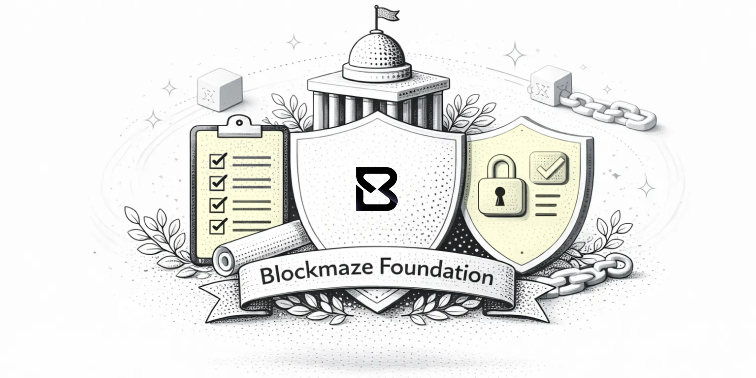
Establishing protocol-level governance and verified issuer accountability across the Blockmaze layer 0 blockchain ecosystem while preserving independent and irreversible settlement.

About the Foundation

The Blockmaze foundation is an independent, non-profit organization responsible for the governance architecture and accountability framework of the Blockmaze Layer-0 protocol. As a foundation supporting a regulated blockchain for RWAs, it maintains issuer registries, token standard approvals, proof cadence oversight, and governance processes that apply across all connected chains. Its role is limited to defining issuer eligibility, monitoring ongoing obligations, managing standing transitions, and maintaining protocol registries that record these decisions on-chain within a blockchain governance framework.

Vision

To support a blockchain foundation where real-world assets can be issued under verified authorization, structured disclosure, and transparent oversight, while transaction settlement remains neutral and final.

  • On-chain verification of issuer identity and authorization
  • Scheduled disclosure requirements tied to asset type
  • Public visibility into issuer standing
  • Separation of governance controls from settlement finality
  • Permanent record of issuer status changes

Mission

To maintain protocol-level governance structures, issuer verification standards, token templates, and proof enforcement mechanisms that provide a consistent accountability framework for real-world asset tokenization for institutions across the Blockmaze ecosystem.

  • Structured review and admission of corporate issuers
  • Oversight of approved token template versions
  • Monitoring and automatic handling of missed proof deadlines
  • Management of issuer permission states
  • Governance of protocol parameters related to accountability

Core Problems

The Accountability Gap in Existing Blockchain Networks

Anonymous Issuer Access

Most public networks allow asset issuance without identity verification or authorization checks. The protocol does not distinguish between a licensed issuer and an unidentified contract deployer. There is no native registry confirming who may issue assets or under what legal basis.

Unrestricted Token Deployment

Token contracts can be created without standardized templates, governance review, or defined issuance conditions. Asset categories, disclosure requirements, and operational constraints are left to individual applications rather than embedded at the network layer of a blockchain for asset tokenization.

Absence of Proof Monitoring

Disclosure schedules and reserve attestations are handled outside the protocol. The network does not track proof deadlines, record missed submissions, or signal changes in issuer standing when obligations are not met, limiting institutional confidence in RWA tokenization.

No Distinction Between Asset Types

Bearer-redeemable assets and registry-dependent title assets are treated as identical token contracts. The protocol does not enforce reserve visibility for bearer assets or registry alignment for title-based assets, despite their differing legal realities in compliant asset tokenization environments.

Governance Detached From Issuer Permissions

Governance mechanisms, where present, often focus on protocol upgrades rather than issuer eligibility or enforcement. There are no structured state transitions governing admission, restriction, or revocation at the protocol root within an on chain governance platform.

Institutional Participation Constraints

Without verified attribution, standardized issuance templates, structured disclosure requirements, and permission controls, regulated entities face structural limitations in adopting public blockchain infrastructure for real-world assets.
The Blockmaze Accountability Model

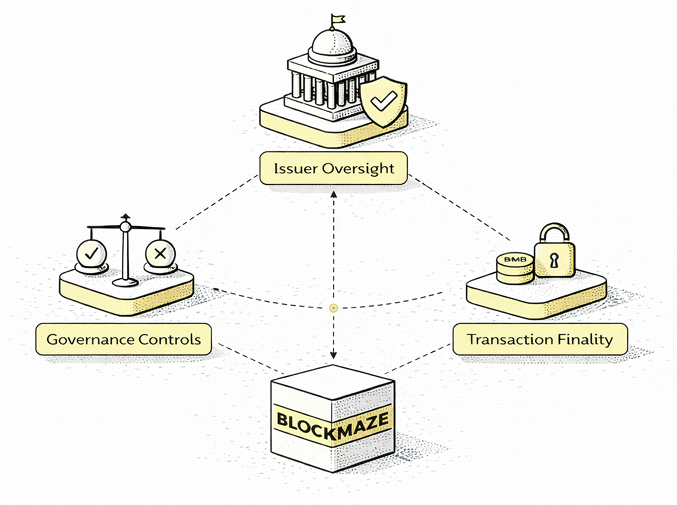
Blockmaze addresses the accountability gap at its foundation by embedding issuer oversight directly at the protocol layer rather than leaving it to individual applications. It separates settlement from issuer responsibility, defining clear boundaries between governance controls and transaction finality within a compliant Web3 infrastructure.
  • Requires bonded commitments as a condition of issuer eligibility
  • Enforces scheduled proof submissions based on asset classification
  • Records standing transitions on-chain when obligations are missed
  • Restricts governance authority to permissions, template approvals, and enforcement actions
  • Maintains an independent settlement governed solely by consensus rules

Primary USPs

What Distinguishes Blockmaze

Blockmaze embeds issuer accountability at the protocol root rather than relying on application-level controls. Its architecture separates settlement from oversight, defines structured issuer admission, and applies standardized token behavior across connected chains.

Accountability at Layer-0

Issuer registries, proof schedules, and standing transitions operate at the protocol level. These rules apply consistently across all connected domains.

Verified Issuer Admission

Corporate issuers must complete identity verification, demonstrate legal authorization, and bond economic commitments before deploying assets.

Asset-Specific Token Standards

Two standardized templates reflect distinct legal realities: BMZ20 for bearer-redeemable assets and BMZ3643 for registry-dependent title assets, supporting structured RWA issuance platform requirements.

Enforced Disclosure Cadence

Proof-of-reserves and proof-of-presence deadlines are monitored by protocol modules. Missed submissions trigger visible standing changes, reinforcing compliant asset tokenization practices.

Governance With Defined Boundaries

Governance manages issuer permissions and protocol parameters within a defined blockchain governance framework. It cannot reverse transactions or interfere with settlement history.

Hybrid Layer-0 / Sovereign Model

Issuers may operate directly on the root chain or deploy jurisdiction-specific Layer-1 domains connected through shared accountability primitives using a sovereign blockchain SDK.

Use Cases

Top Blockmaze Use Cases

Blockmaze supports asset issuance models where verified authorization, structured disclosure, and protocol-level accountability are required.

Sovereign or Jurisdiction-Specific Asset Platforms

Governments or regulated authorities can deploy sovereign domains connected to the layer-0 blockchain, maintaining local execution control while inheriting shared accountability registries.

Institutional Asset Distribution Networks

Regulated asset managers can distribute tokenized securities or structured products under defined issuer permissions, standardized templates, and transparent standing rules.

Cross-Chain Settlement With Issuer Visibility

Assets issued on sovereign domains can interoperate across connected chains while preserving issuer standing checks and registry references anchored at Layer-0, strengthening the architecture of a regulated blockchain for RWAs.

Regulated Stablecoin Issuance

Licensed financial entities can issue fiat-redeemable tokens under defined proof-of-reserves schedules, with issuer standing and disclosure history recorded on-chain.

Tokenized Real Estate and Registry-Based Assets

Title-dependent assets can be issued using structured templates that require whitelist controls, registry coherence commitments, and proof-of-presence attestations aligned with how to tokenize real estate legally.

Commodity-Backed Digital Instruments

Producers and custodians can tokenize gold on blockchain or issue bearer-redeemable tokens representing commodities such as energy resources, with reserve attestations tied to protocol-enforced proof cadence. This model supports tokenized gold with proof of reserve requirements.

Governance & Ecosystem

Blockmaze operates through defined governance channels and structured access layers that support issuer oversight, validator coordination, ecosystem funding, and network participation. Each component serves a distinct function within the Layer-0 framework.

Governance Council

The Governance Council oversees issuer admission, standing reviews, enforcement actions, and protocol parameters related to accountability. Governance decisions are recorded on-chain within defined authority boundaries and do not interfere with settlement history.

  • Reviews corporate issuer applications and authorization status
  • Manages standing transitions, restrictions, and revocations
  • Oversees protocol parameters tied to accountability frameworks

RFP

The RFP function manages ecosystem proposals, research initiatives, and structured funding programs aligned with network standards and accountability requirements.

  • Accepts proposals for tooling, standards, and infrastructure development
  • Facilitates grant evaluation and milestone tracking
  • Records approved initiatives under governance oversight

DAO

The DAO enables broader participation in governance through proposal submission, voting, and treasury oversight using governance tokens within defined voting rules.

  • Enables proposal submission subject to deposit thresholds
  • Conducts structured voting under defined quorum rules
  • Oversees treasury allocation tied to approved proposals

Validator

The validator interface supports onboarding and coordination for entities running a proof of stake validator on the layer 0 blockchain.

  • Facilitates validator registration and staking setup
  • Provides access to network policy and performance standards
  • Tracks validator uptime and slashing conditions

Delegator

The delegator interface allows BMZ holders to delegate stake to validators, contributing to network security without operating infrastructure.

  • Enables users to delegate crypto staking to verified validators
  • Tracks validator node rewards and commission rates
  • Reflects proportional exposure to validator performance

Swap

The swap interface supports protocol-native asset exchange within the Blockmaze ecosystem, settling transactions under Layer-0 consensus rules.

  • Enables on-chain asset pair swaps
  • Supports liquidity participation for approved tokens
  • Settles trades under network finality rules

Blockmaze Documentation & Resources
Blogs

Latest Research & Featured Blog Posts

Recent publications highlight governance design, ecosystem development, validator infrastructure, developer tooling and research supporting compliant Web3 infrastructure and regulated digital asset markets.

Why Smart Contracts Cannot Represent Legal Ownership Alone

Why Smart Contracts Cannot Represent Legal Ownership Alone

A Developing Market Catching Up With Its Legal Framework The data available to date reveals a lot of information about this fast-developing market.  The tokenized real-world asset market has recently grown to an approximate $24.9 billion total market value, growing...

Why Tokenization Infrastructure Must Reflect Legal Ownership Systems

Why Tokenization Infrastructure Must Reflect Legal Ownership Systems

The rise of real world asset tokenization as a means of representing ownership rights digitally has been one of the major emerging trends in the modern financial space. Blockchain is rapidly being adopted across real estate, commodities, equities, and various forms of...

FAQ

Frequently Asked Questions

1. What role does the Blockmaze Foundation perform within the network?
The Foundation maintains issuer registries, token standard approvals, proof cadence oversight, and governance processes at Layer-0 blockchain. It manages permissions and accountability structures without interfering with transaction settlement or consensus.
2. Does governance have the authority to reverse transactions?
No. Settlement is governed exclusively by consensus rules within the layer 0 protocol. Once a block is finalized, it cannot be reversed. Governance actions apply only to issuer permissions and protocol parameters under the established blockchain governance framework, ensuring separation between oversight and settlement.
3. How are corporate issuers admitted to the network?
Corporate issuers must complete identity verification, demonstrate legal authorization for the asset category, bond BMZ, and accept defined proof schedules before participating in the institutional tokenization platform. Approval is recorded in the Issuer Registry prior to asset deployment within the real-world asset tokenization platform.
4. What happens if an issuer fails to submit the required proofs?
Missed proof deadlines trigger automatic standing transitions recorded on-chain within the regulated RWA tokenization platform. Governance may impose restrictions or revoke issuance permissions. Previously issued tokens remain transferable, but minting and burning rights can be suspended to preserve accountability standards in compliant asset tokenization.
5. What is the difference between BMZ20 and BMZ3643?
BMZ20 applies to bearer-redeemable assets where possession enables redemption. BMZ3643 applies to registry-dependent assets where ownership relies on alignment with an external legal registry. Each template enforces different operational rules.
6. Can sovereign entities operate independently within the ecosystem?
Yes. Sovereign domains may operate their own execution environments and validator sets while connecting to the layer 0 blockchain for shared registry references and cross-chain coordination. Governance at Layer-0 does not override sovereign authority, preserving flexibility within the broader compliant Web3 infrastructure.