
About the Blockmaze Foundation & Ecosystem
Independent Governance for Regulated, Real-World Blockchain Infrastructure
The Blockmaze foundation maintains the governance architecture of the Blockmaze Layer-0 network, including issuer admission standards, on-chain registries, and permission frameworks.
The Blockmaze Foundation
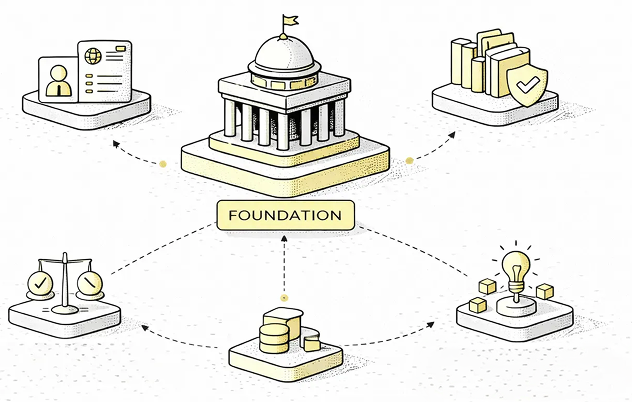
The Blockmaze foundation is an independent, non-profit entity responsible for overseeing governance and issuer accountability at the Layer-0 level. It defines issuer eligibility, manages registries, enforces proof requirements, and administers governance actions within clearly defined authority boundaries. It also supports research, grants, and ecosystem initiatives that strengthen validator participation and developer engagement within the network’s governance framework.
- Define issuer admission and authorization requirements
- Approve and maintain standardized token templates
- Enforce scheduled proof submissions
- Record standing changes and enforcement outcomes
- Execute governance decisions within defined limits
- Support ecosystem programs aligned with protocol standards
The Role of the Blockmaze Foundation

Governance Stewardship
The foundation stewards governance processes that define issuer permissions, protocol parameters, and accountability boundaries at Layer-0.

Boundary Enforcement
It maintains a clear separation between governance authority, transaction settlement, asset issuance, and market activity within the ecosystem.
Accountability Oversight
The Foundation ensures that issuer standing, enforcement actions, and governance decisions are recorded transparently through on-chain processes.
Institutional Coordination
It engages regulated entities, validators, and ecosystem contributors within defined governance structures without participating in commercial operations.

Policy Execution
Governance outcomes are translated into protocol-level state changes affecting permissions and standards, while preserving consensus integrity.

Ecosystem Support
The Foundation supports structured research, grant initiatives, and technical collaboration aligned with the accountability framework of the network.
How the Blockmaze Ecosystem Works
Layer-0 Root Network
The root chain provides consensus, final settlement, shared registries, and cross-chain coordination. It anchors issuer standing, governance decisions, and accountability records while maintaining independent transaction finality.
Sovereign Domains
Jurisdictions or regulated entities may deploy sovereign chains connected to the Layer-0 root. These domains retain local execution control while referencing shared registries and accountability primitives.
Issuer Framework
Corporate issuers undergo admission review before deploying assets. Approved issuers are recorded on-chain with defined permissions and proof schedules. Standing transitions occur automatically when obligations are not met.

Validator Participation
Validators secure the root network through staking and consensus participation. Slashing rules and performance standards maintain network integrity.
Token Standards
Assets are deployed using standardized templates designed for distinct legal realities. These templates encode operational rules, disclosure requirements, and permission controls directly into token behavior.
Application & Market Infrastructure
Developers build applications aligned with approved token standards and governance boundaries. Asset exchange and liquidity mechanisms settle under Layer-0 consensus without altering issuer accountability rules.
Why Accountability Must Be Embedded at the Protocol Layer

Settlement Does Not Verify Issuer Authority
Transaction finality confirms that a transfer occurred. It does not confirm whether the issuer has legal authorization or maintains required backing.

Real-World Assets Carry External Obligations
Assets tied to reserves, registries, or regulated frameworks depend on off-chain commitments. These commitments must be defined and monitored through structured protocol rules.

Application-Level Controls Create Fragmentation
When each platform defines its own compliance logic, standards vary, and oversight becomes inconsistent. This weakens credibility across networks.

Shared Registries Provide Consistency
Embedding issuer eligibility and standing records at Layer-0 ensures that accountability signals apply uniformly across connected chains.

Enforcement Requires Defined Boundaries
Accountability mechanisms must operate within clear authority limits. Governance can adjust permissions and record standing changes without interfering with settlement.

Separation Preserves Neutral Finality
By separating issuer responsibility from consensus, transaction history remains irreversible while accountability remains structured and visible at the protocol level.
Long-Term Vision for Blockmaze
The long-term vision of Blockmaze is to serve as foundational infrastructure for real-world asset issuance across jurisdictions while preserving settlement integrity and defined governance boundaries.

Broader participation from regulated issuers

Expansion of sovereign domains aligned with local requirements

Increased validator distribution across the network

Wider adoption of standardized asset templates

Gradual expansion of governance participation

Ongoing refinement of accountability standards
Leadership & Management
The Blockmaze foundation is guided by a management team responsible for maintaining governance integrity, operational discipline, and structured oversight across the Layer-0 network. The team brings experience across blockchain architecture, regulatory frameworks, financial systems, and protocol governance. Their responsibility is to ensure that accountability standards remain consistent, documented, and enforceable as the ecosystem expands.

Tajinder Virk
Co-Founder & CEO, Blockmaze

Tajinder Virk is a global fintech architect and institution builder with a track record of launching and scaling regulated financial ecosystems across multiple jurisdictions. As Co-Founder and CEO of Blockmaze, he leads the strategic vision of building a sovereign-ready, trust-enforced real-world asset blockchain designed to bridge traditional finance with programmable infrastructure. With deep expertise spanning wealth Management, investment banking, payments, and cross-border regulatory frameworks, Tajinder focuses on designing systems that eliminate structural conflicts of interest, restore transparency, and create durable financial rails for the next generation of global asset ownership.

Puneet Mangla
Co-Founder & Chief Operating Officer, Blockmaze
Puneet Mangla is a seasoned entrepreneur with extensive experience in manufacturing, distribution, and global trade of metals and steel products, along with strategic venture-style investments in emerging businesses. As Co-Founder and COO of Blockmaze, he oversees operational execution, infrastructure build-out, and institutional partnerships. His background in real-world asset industries brings grounded commercial insight to Blockmaze’s tokenization framework, ensuring that digital representations of assets are anchored in practical supply chain realities, capital discipline, and scalable operational processes.

Sarvjeet Virk
Strategic Advisor, Blockmaze
Sarvjeet Virk is a technology-focused entrepreneur with deep experience in building regulated financial platforms and high-performance trading infrastructure. As an Advisor to Blockmaze, he provides strategic oversight on technology architecture, scalability, and governance design. With a strong foundation in developing compliant, resilient financial systems across global markets, Sarvjeet plays a critical role in shaping Blockmaze’s institutional-grade reliability and long-term technological durability.
FAQ
Frequently Asked Questions
1. What is the primary responsibility of the Blockmaze Foundation?
The Foundation oversees governance administration, issuer eligibility standards, registry maintenance, and accountability processes at the Layer-0 level. It does not operate markets or control transaction settlement.
2. How does the Foundation interact with issuers?
Governance is coordinated across the Foundation, the Governance Council, and a dedicated DAO governance platform supporting structured decentralized decision-making.
3. Can governance reverse or modify past transactions?
No. Blockchain transactions are immutable once confirmed on-chain — governance cannot alter, void, or reverse historical transaction records under any circumstance. Governance authority applies to future protocol parameters, compliance module updates, validator requirements, and smart contract behaviour through the DAO’s formal proposal and voting process, but the ledger itself is permanent and tamper-proof.
4. What role does the DAO play within the ecosystem?
Developers, validators, and partners may submit proposals, grant applications, and infrastructure requests through the RFP Portal and access tooling via the Developer Portal for review under structured ecosystem programs.
5. How does Blockmaze support regulated participation?
The foundation maintains separation from commercial operations, market execution, and protocol authority while supporting governance design, validator standards, developer frameworks, and technical standards.