
Smart contracts are often described in terms that make them sound nearly self-governing: ‘self-executing agreements,’ ‘code that runs automatically,’ ‘trustless automation.’ For institutional asset management, this description is accurate but incomplete. Smart contracts do execute automatically but they execute the conditions they have been given. Someone still has to specify those conditions correctly, and someone still has to make the underlying decisions those conditions are meant to reflect. Understanding precisely where the automation boundary sits in asset lifecycle management is what separates useful technical communication from marketing prose.
The Six Stages of a Tokenized Asset’s Lifecycle
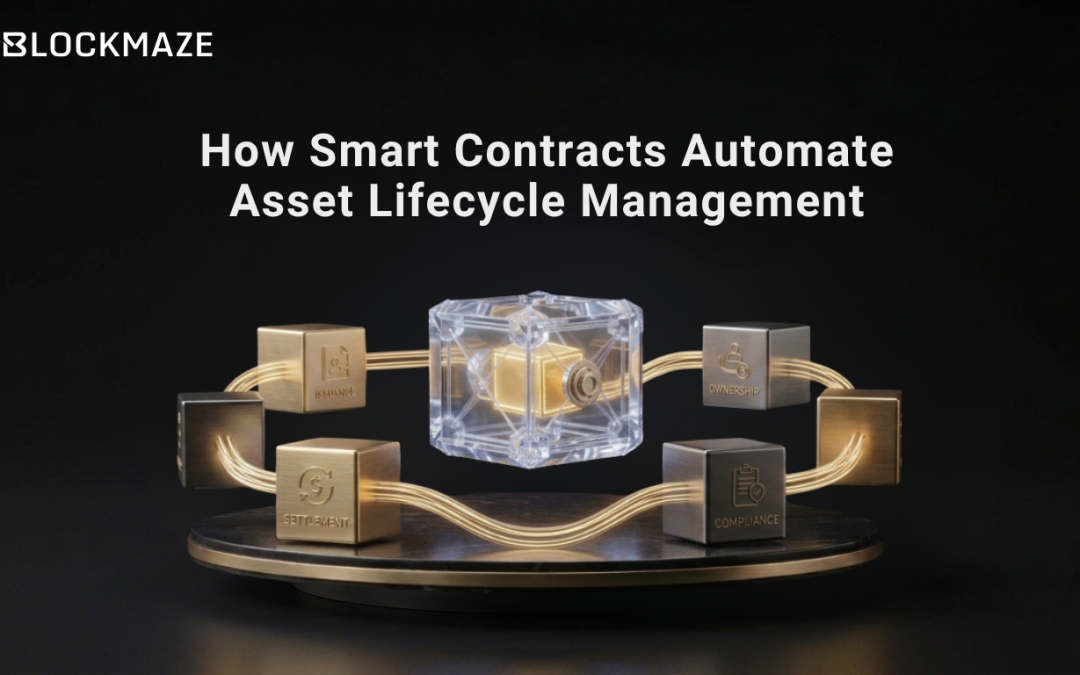
A tokenized asset moves through six identifiable stages from initial creation to final settlement or redemption. Smart contract automation applies differently — and to different extents — at each stage.
| Stage | Description | Automation Potential |
|---|---|---|
| 1. Token Creation & Issuance | Defining token parameters, minting tokens, establishing compliance rules | High — parameters encoded once, mint function executes on governance approval |
| 2. Investor Distribution | Whitelisting eligible investors, enabling transfers, KYC/KYB enforcement | High — identity registry and transfer restrictions enforced programmatically |
| 3. Corporate Action Administration | Dividends, coupons, votes, redemption offers, splits | Medium — calculation and distribution automated; decision to execute remains human |
| 4. Secondary Market Trading | Transfer of tokens between eligible investors | High — eligibility checked and settlement executed atomically |
| 5. Compliance & Reporting | Transfer monitoring, reserve attestation, regulatory reporting | Medium — onchain data available in real time; formal regulatory reports still require structured output |
| 6. Redemption & Maturity | Return of capital, token burn, final distribution | High — trigger conditions executable in smart contract once maturity terms are met |
Stage 1: Token Creation and Issuance
The issuance stage is where the asset’s entire lifecycle logic is encoded. This includes the token’s supply cap, the compliance module defining which wallets can hold it and under what conditions, the jurisdiction-specific eligibility rules, any lock-up or vesting terms, and the corporate action hooks that will govern future events. Once encoded and deployed, these parameters govern every subsequent transaction without requiring manual intervention.
What automation cannot determine is whether the issuance itself should proceed that is a governance decision. On Blockmaze, every issuance proposal goes through a formal DAO vote by the decentralized council using quadratic voting. The smart contract executes the issuance; the governance process decides whether it should.
Stage 2: Investor Distribution and Onboarding
Distribution is where whitelisting and identity verification, discussed in detail in earlier articles in this series, produce their most visible operational impact. An investor who has completed KYC/KYB and received a valid claim from a claim issuer is automatically eligible to receive tokens the smart contract checks their wallet against the identity registry at the point of transfer and admits or rejects them deterministically. There is no manual approval queue, no waiting for a back-office team to process the application the eligibility check is the admission process.
The operational team’s role shifts from processing individual investor onboardings to maintaining the claim issuance infrastructure and the identity registry a set-up-once, monitor-continuously function rather than a transaction-by-transaction one.
Stage 3: Corporate Action Administration
Corporate actions dividend payments, coupon distributions, redemption offers, proxy votes are where the automation boundary is most instructive. Smart contracts can execute corporate actions with very high precision and very low operational overhead: a coupon payment, for example, requires calculating the pro-rata distribution to all whitelisted holders, executing the payment simultaneously to all of them, and recording the event onchain all as a single automated execution triggered by a defined condition (e.g., a date, or a governance approval signal).
What smart contracts cannot do is decide that the coupon should be paid, at what rate, or on what date. These are issuer decisions governance decisions that must be encoded into the contract’s conditions at issuance or formally approved through a governance process before the automated execution can take place. A smart contract that executes an incorrect or unauthorized dividend payment because a parameter was specified wrongly is worse than no automation at all, because it executes instantly and at scale. This is why the governance layer surrounding the smart contract not the smart contract itself is where institutional risk management is primarily concentrated.
Stage 4: Secondary Market Trading
For secondary market transfers between eligible investors, smart contract automation is most comprehensive and most valuable. A transfer attempt triggers an automatic check of the recipient’s whitelist status and eligibility under the token’s compliance module; if eligible, the transfer and the register update are a single atomic event with T+0 finality. No separate settlement instruction, no clearing delay, no possibility of the trade recording and the register update becoming desynchronized.
This is a qualitatively different settlement experience from traditional securities not faster processing of the same workflow, but elimination of the workflow’s most operationally fragile steps. The practical consequence for secondary markets is that tokenized securities can offer 24/7 trading with same-block settlement finality, compared to the end-of-day cutoffs and multi-day settlement windows that characterize most traditional markets.
Stage 5: Compliance and Reporting
Onchain compliance monitoring has a structural advantage over traditional compliance reporting that is easy to underestimate: every relevant event every transfer, every whitelist check, every compliance rule evaluation is recorded permanently and in real time on the ledger. A compliance or operations team can query the full history of any asset, any wallet, any transfer at any point rather than assembling it from periodic reports and system logs after the fact.
Formal regulatory reporting structured filings with specific formatting, defined data fields, and jurisdiction-specific content requirements still require a structured output layer that translates the onchain data into the required format. The data quality is higher, and the real-time availability is a material improvement, but the report itself is still a human-controlled output rather than an automatic publication.
Stage 6: Redemption and Maturity
Redemption is one of the cleanest automation use cases in the lifecycle. For an asset with defined maturity terms a fixed-income instrument returning principal at a specific date, or a fund with a defined redemption schedule — the smart contract can be programmed to automatically calculate each holder’s redemption entitlement, distribute proceeds, and burn the corresponding tokens when the trigger condition is met. The entire operation executes simultaneously for all holders with no processing lag and no manual administration.
Where this requires careful design is in the specification of the trigger condition itself. A maturity date is straightforward; a redemption triggered by an external event (reaching a NAV threshold, a regulatory event, an issuer decision) requires an oracle to bring that external data onchain — a function covered in depth in the next article in this series on the role of oracles.
What Smart Contracts Cannot Automate
- The governance decisions underlying each lifecycle event: declaring dividends, approving issuances, setting redemption terms. These require accountable human decision-makers.
- Verification that the real-world asset behind the token is correctly represented: custody, valuation, and existence verification are off-chain functions requiring independent attestation.
- Interpretation of novel legal situations: a smart contract enforces the rules it has been given; it cannot interpret ambiguous legal language or respond to circumstances its parameters were not designed to anticipate.
- Structured regulatory reporting: the raw data is onchain; translating it into jurisdiction-specific filing formats still requires a structured output and human review.
This division clarifies where operational teams can realistically eliminate headcount versus where they need to redirect it. The functions that become automated transfer processing, eligibility checks, coupon calculation, investor notification were traditionally handled by large operations teams across custodians, transfer agents, and fund administrators. The functions that remain governance, legal interpretation, regulatory filing, off-chain asset verification were and remain the higher-judgment work. Lifecycle automation does not eliminate operations; it concentrates operations on the decisions that actually require human judgment.
The Specification Problem: Why Getting Conditions Right Matters More Than Getting Code Right
One of the most important practical lessons from institutional tokenization deployments is that the greatest risk is not a bug in the smart contract code; it is incorrectly specified conditions that the code executes perfectly. A contract that correctly pays dividends to all whitelisted holders on the first of every month is only as valuable as the correctness of the dividend rate and the accuracy of the whitelist. A contract that burns tokens at maturity is only as safe as the accuracy of the maturity date and the precision of the redemption calculation.
This is why sophisticated institutional platforms treat smart contract specification as a governance and legal exercise, not just a technical one. Before any lifecycle automation can be trusted, the conditions it operates on need to have been reviewed for legal accuracy, validated against the offering documents, and approved through a formal governance process not simply programmed and deployed. The speed advantage of automated execution only materializes reliably when the specification process is treated with the same rigor as the code itself.
How Blockmaze Structures Lifecycle Automation
Blockmaze approaches lifecycle automation as a division between execution and governance. Smart contract logic handles the execution side: transfer eligibility, settlement finality, corporate action distribution, and redemption processing automatically and deterministically. The governance side issuance approval, material rule changes, and emergency actions such as issuer blacklisting goes through the DAO’s formal proposal and quadratic-voting process, with every decision recorded onchain and available for audit. Proof of Reserve attestations, which are off-chain verification events, are on a mandatory 15-day cycle by independent third parties, feeding the onchain record rather than replacing it.
Frequently Asked Questions
1. Can smart contracts pay dividends automatically?
Yes, the calculation and distribution of dividends to all eligible holders can be fully automated once the dividend declaration has been made. The automated step is execution; the governance step — deciding to declare the dividend and at what rate — remains a human decision.
2. Do smart contracts need external data to function?
For events triggered by external conditions — market prices, NAV calculations, off-chain corporate actions — smart contracts require oracle services to bring verified external data onchain. Events triggered only by onchain conditions (dates, balances, transfer counts) do not.
3. What happens if a smart contract has a bug?
Smart contract bugs can execute incorrectly and at scale, which is why independent security audits and formal governance over contract upgrades are critical components of institutional tokenization infrastructure. Well-designed platforms separate upgradeable compliance logic from core token parameters to minimize the surface area of risk.
4. Is corporate action automation on tokenized assets proven in production?
Yes — coupon payments, NAV calculations, and subscription/redemption processing on tokenized funds have been demonstrated in production through multiple institutional deployments including MAS Project Guardian pilots involving UBS, ANZ, and Fidelity International using Chainlink infrastructure.
5. How does Blockmaze handle lifecycle events that require governance?
Material lifecycle decisions — issuance approval, significant rule changes, emergency actions — go through Blockmaze’s DAO governance process: a formal proposal followed by a quadratic vote by the decentralized council. Execution then happens automatically once the governance condition is satisfied.
Disclaimer: This article is for informational purposes only and does not constitute financial or legal advice. Readers should conduct their own research and consult with qualified professionals before making any investment or business decisions.