Introduction
The tokenization of real-world assets (RWAs) represents one of the most significant opportunities in the history of financial markets. With global investable assets estimated at over $500 trillion**—yet only approximately **$40 billion currently tokenized—the race to build the infrastructure that will power this transformation is intensifying.
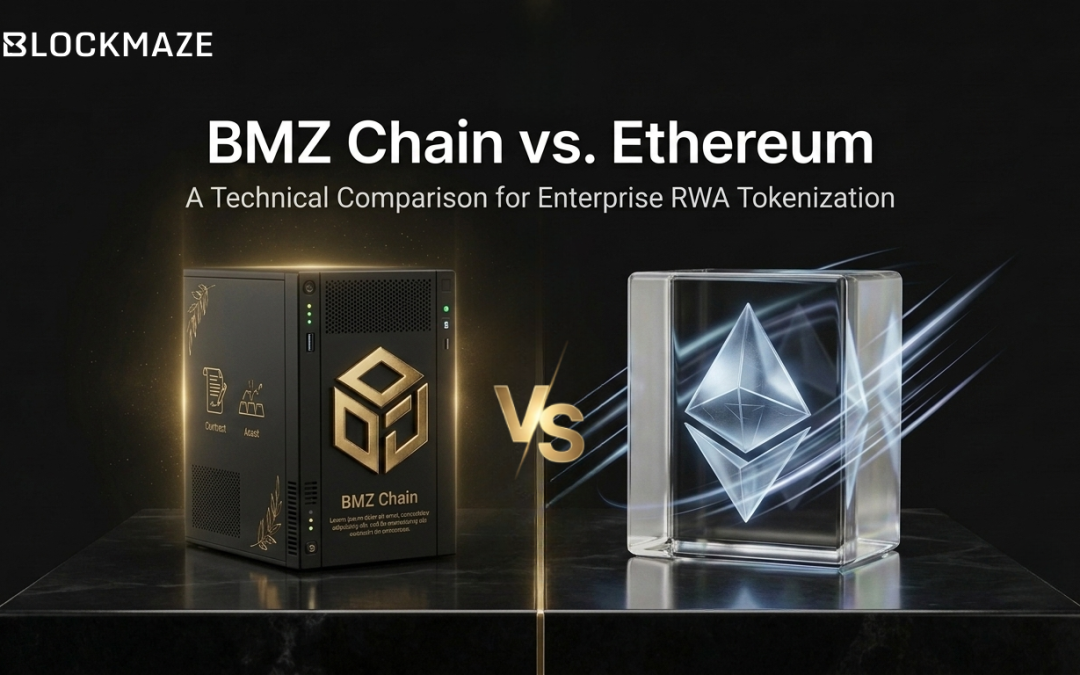
Two blockchains have emerged as leading contenders in this space, but they represent fundamentally different approaches to solving the same problem. On one side stands Ethereum, the pioneering smart contract platform and the current undisputed leader in RWA tokenization. On the other stands BMZ Chain (Blockmaze) , a new, specialized Layer-1 blockchain built from the ground up for compliant RWA tokenization.
This article provides an in-depth technical comparison of BMZ Chain and Ethereum across four critical dimensions—approach to RWA tokenization, regulation and compliance, technology and architecture, and maturity and ecosystem—to help enterprises determine which platform best serves their institutional asset tokenization needs.
Approach to RWA Tokenization: Purpose-Built vs. General-Purpose
BMZ Chain: Designed Specifically for RWA Tokenization
BMZ Chain is not a general-purpose blockchain that happens to support RWA tokenization. It is a Layer-1 blockchain infrastructure designed specifically to power the tokenization of real-world assets.
Every aspect of BMZ Chain’s architecture is optimized for a single purpose: ensuring that tokenized assets are “legally recognised, compliant, and connected to real-world ownership”. The platform is designed to bridge the critical gap between digital tokens and legally recognized ownership—a challenge that BMZ Chain’s leadership identifies as the industry’s most significant barrier to adoption.
As Tajinder Virk, Co-Founder & CEO of Blockmaze and Finvasia Group, stated: “While the technology to create tokens already exists, the biggest challenge has always been connecting those tokens to real-world ownership, regulatory acceptance, and institutional trust. This is the gap Blockmaze was built to solve” .
BMZ Chain’s approach is characterized by:
- Asset-backed tokenization: Every token on BMZ Chain is tied to a verified, audited, and redeemable real-world asset, issued only by licensed and KYC-verified entities.
- Integrated compliance: Compliance is embedded at the core of the infrastructure rather than treated as an additional layer.
- Ready-to-launch solutions: The platform provides comprehensive solutions for issuers, institutions, brokers, exchanges, and financial platforms.
Ethereum: The General-Purpose Pioneer
Ethereum takes a fundamentally different approach. As a general-purpose smart contract platform, Ethereum was not designed specifically for RWA tokenization. Instead, it provides the foundational infrastructure upon which developers can build RWA tokenization applications.
Ethereum’s approach is characterized by:
- Application-level compliance: Compliance and legal recognition are handled at the application level through smart contracts, not at the protocol level.
- Flexibility and composability: Developers can build any type of application, including RWA tokenization, using Ethereum’s smart contract capabilities.
- EVM compatibility: The Ethereum Virtual Machine (EVM) has become the industry standard, enabling a vast ecosystem of compatible tools and applications.
Despite being a general-purpose platform, Ethereum has become the dominant network for RWA tokenization. As of mid-2026, Ethereum hosts approximately 60–68% of all active tokenized RWA value. Tokenized U.S. Treasuries alone approached $15 billion on-chain by mid-2026.
Approach Verdict
| Aspect | BMZ Chain | Ethereum |
| Design Philosophy | Purpose-built for RWA tokenization | General-purpose smart contract platform |
| Compliance Integration | Protocol-level, embedded | Application-level, flexible |
| Asset Types | Real-world assets with legal recognition | Any digital or tokenized asset |
| Primary Strength | Legal certainty and regulatory compliance | Flexibility and ecosystem breadth |
For enterprises seeking a purpose-built, compliance-first infrastructure for RWA tokenization, BMZ Chain offers a specialized solution. For those seeking maximum flexibility, composability, and access to a vast ecosystem, Ethereum provides an unparalleled platform.
Regulation & Compliance: Protocol-Level vs. Application-Level
BMZ Chain: Built with Regulatory Licenses and KYC/AML Requirements
BMZ Chain’s defining characteristic is its compliance-first infrastructure. The platform is built “for compliant players, by compliant players” and is designed to bring trust, transparency, and legal recognition to tokenized assets.
Key compliance features include:
- 45+ regulatory registrations across Europe, the GCC, and Asia
- Licenses across eight jurisdictions
- Licensed and KYC-verified entities: Only licensed entities can issue tokens on BMZ Chain
- Verified and audited assets: Every token is tied to a verified, audited, and redeemable real-world asset
- Embedded compliance: Compliance is embedded at the core of the infrastructure rather than treated as an additional layer
BMZ Chain’s regulatory foundation is not an afterthought—it is the platform’s primary value proposition. The platform enables issuers to build tokenized assets “supported by licensing, verification, and connectivity with traditional financial systems”.
As BMZ Chain’s leadership emphasizes: “The next era of tokenisation will not be defined by who can create compliant and licensed digital tokens the fastest. It will be defined by who can create trusted, legally recognised assets backed by strong regulatory frameworks”.
Ethereum: Permissionless and Decentralized
Ethereum operates as a permissionless, decentralized network—a fundamentally different model from BMZ Chain’s regulated approach. Key characteristics include:
- Permissionless access: Anyone can deploy smart contracts and interact with the network without KYC requirements
- Decentralized governance: The network is governed by a distributed community of validators and developers
- No native compliance features: Compliance is not built into the protocol; it must be implemented at the application level
- Flexibility for regulated applications: Institutions can build compliant applications on top of Ethereum, but compliance is the responsibility of the application developer
Ethereum’s permissionless nature offers significant advantages for innovation and accessibility. However, it also means that enterprises bear the full responsibility for ensuring regulatory compliance.
Despite this, Ethereum has demonstrated its viability for institutional use. Major institutions including BlackRock, Franklin Templeton, and JPMorgan have all launched or expanded tokenized fund offerings on Ethereum. The network has become the primary settlement layer for institutional-grade tokenized assets.
Regulatory Verdict
| Aspect | BMZ Chain | Ethereum |
| Compliance Model | Protocol-level, embedded | Application-level, flexible |
| Regulatory Registrations | 45+ across Europe, GCC, Asia | Network-level; issuers handle compliance |
| Licenses | 8 jurisdictions | N/A |
| Issuance Requirements | Licensed, KYC-verified entities | Permissionless |
| Legal Recognition | Built into asset issuance | Depends on issuer’s implementation |
| Best For | Regulated institutions seeking legal certainty | Flexible, innovative projects comfortable with compliance responsibility |
For enterprises operating in regulated environments where legal recognition is non-negotiable, BMZ Chain’s compliance-first infrastructure offers significant advantages. For organizations prioritizing flexibility, innovation, and global accessibility, Ethereum’s permissionless model with growing institutional tooling provides a proven path forward.
Technology & Architecture: Financial Operating System vs. Ethereum Virtual Machine
BMZ Chain: A Layer-1 Financial Operating System
BMZ Chain is a dedicated Layer-1 blockchain infrastructure designed specifically for RWA tokenization. The platform positions itself as a “financial operating system for a future where value moves without friction”.
Key architectural characteristics include:
- Layer-1 infrastructure: BMZ Chain is a standalone Layer-1 blockchain, not a Layer-2 or application built on top of an existing network
- Regulated financial infrastructure: Designed for secure, transparent, and legally recognized asset movement
- Compliance-first design: Architecture prioritizes security, compliance, and institutional suitability
- Asset-backed token model: Every token is tied to verified, audited, and redeemable real-world assets
- Integrated ecosystem: Includes IBANs, wallets, debit cards, borrowing against tokens, and merchant payment infrastructure
BMZ Chain’s architecture is designed to solve the fragmentation that plagues most RWA stacks, where issuance, custody, payments, and compliance are assembled from disparate parts. By building an integrated, compliance-first infrastructure from the ground up, BMZ Chain aims to provide a seamless experience for issuers and institutions.
Important Clarification: Two Distinct “BlockMaze” Projects
It is important to note that there is academic research on a privacy-focused project also called “BlockMaze”, which is based on zk-SNARKs and Go-Ethereum. This is a separate and distinct project from the commercial Blockmaze (BMZ) discussed in this article.
The commercial Blockmaze (BMZ) is a regulated, asset-backed blockchain ecosystem backed by the Finvasia Group, focused on bridging traditional finance and the digital asset economy. It is a Layer-1 infrastructure designed specifically for compliant RWA tokenization, not a privacy-focused research project.
Ethereum: The Ethereum Virtual Machine and Vast Developer Ecosystem
Ethereum’s technology architecture is the foundation of its dominance:
- Ethereum Virtual Machine (EVM): The EVM is the runtime environment for smart contracts on Ethereum. It has become the industry standard, with numerous compatible networks (Layer-2s, sidechains, and alternative Layer-1s) supporting EVM compatibility.
- Smart contract functionality: Ethereum enables developers to build complex, programmable applications using Solidity and other smart contract languages.
- Proof of Stake consensus: Ethereum transitioned to Proof of Stake (PoS) with The Merge, significantly reducing energy consumption and improving security.
- Layer-2 scaling: Ethereum’s ecosystem includes numerous Layer-2 solutions (Arbitrum, Optimism, Base, etc.) that provide scalability while maintaining security through Ethereum’s settlement layer.
- Vast developer ecosystem: Ethereum has the largest developer community in the blockchain industry, with extensive tooling, libraries, and educational resources.
Ethereum’s architecture prioritizes flexibility, programmability, and composability—enabling developers to build virtually any type of application.
Technology Verdict
| Aspect | BMZ Chain | Ethereum |
| Type | Layer-1 blockchain | Layer-1 blockchain |
| Primary Focus | RWA tokenization | General-purpose smart contracts |
| Virtual Machine | Not publicly specified | Ethereum Virtual Machine (EVM) |
| Programming | Asset-backed token model | Solidity, Vyper, etc. |
| Scalability | Compliance-focused | Layer-2 solutions |
| Differentiator | Legal recognition and compliance | Flexibility, programmability, and ecosystem |
| Note | Distinct from academic “BlockMaze” research project | Industry standard for smart contracts |
For enterprises where legal certainty, compliance, and institutional trust are paramount, BMZ Chain’s architecture offers a purpose-built solution. For developers and businesses requiring maximum programmability, composability, and access to the largest developer ecosystem, Ethereum remains the gold standard.
Maturity & Ecosystem: The Pioneer vs. The Specialist
Ethereum: A Massive, Established Ecosystem
Ethereum’s maturity and ecosystem are unmatched in the blockchain industry:
- Market dominance: Ethereum hosts approximately 60–68% of all active tokenized RWA value as of mid-2026
- Institutional adoption: Major institutions including BlackRock, Franklin Templeton, and JPMorgan have launched tokenized products on Ethereum
- RWA value: Ethereum hosts over $12 billion in RWA value, reinforcing its lead as the primary network for tokenized assets
- Developer ecosystem: The largest developer community in blockchain, with extensive tooling, libraries, and educational resources
- Layer-2 ecosystem: Numerous Layer-2 solutions (Arbitrum, Optimism, Base, etc.) provide scalability while maintaining security through Ethereum
- Proven track record: Ethereum has been operating since 2015, with a proven track record of security and reliability
The RWA tokenization market is projected to grow from approximately $28–34 billion in mid-2026** to **$30 trillion by 2034, driven by Ethereum’s leadership in compliance and liquidity. Ethereum’s established position gives it a significant first-mover advantage.
BMZ Chain: A New, Focused Ecosystem
BMZ Chain is a newer, more focused ecosystem aiming to capture the $500+ trillion tokenization opportunity:
- Specialized focus: BMZ Chain is singularly focused on RWA tokenization, unlike Ethereum’s general-purpose approach
- Regulatory foundation: The platform is built on 45+ regulatory registrations and licenses across eight jurisdictions
- Ready-to-launch solutions: BMZ Chain provides comprehensive solutions for issuers, institutions, brokers, exchanges, and financial platforms
- Backed by Finvasia Group: The platform is backed by a multi-licensed global financial ecosystem
- **Targeting the $500T opportunity**: BMZ Chain is positioned to address the massive gap between the current $40 billion in tokenized assets and the $500+ trillion global asset opportunity
BMZ Chain’s growth comes at a time when the momentum to tokenize RWAs is accelerating worldwide. As governments and regulators worldwide build clearer frameworks for tokenized assets, regulated infrastructure is becoming the foundation for sustainable adoption.
Ecosystem Verdict
| Aspect | BMZ Chain | Ethereum |
| Maturity | Newer, emerging ecosystem | Mature, established since 2015 |
| RWA Market Share | Emerging | ~60-68% of active RWA value |
| RWA Value | Growing | $12B+ |
| Institutional Partners | Financial institutions, issuers | BlackRock, Franklin Templeton, JPMorgan, Visa |
| Developer Ecosystem | Focused on RWA | Largest in blockchain |
| Layer-2 Ecosystem | Not applicable | Extensive |
| Primary Advantage | Regulatory compliance and legal recognition | Scale, liquidity, and ecosystem depth |
For enterprises seeking proven scale, deep liquidity, and access to a vast ecosystem, Ethereum offers an unmatched platform. For enterprises prioritizing regulatory compliance, legal recognition, and a purpose-built RWA infrastructure, BMZ Chain provides a compelling alternative.
Conclusion: Disruption or Complement?
The question of whether specialized Layer-1s like BMZ Chain pose a challenge to Ethereum’s dominance in the RWA space—or whether they will complement the Ethereum ecosystem—is central to understanding the future of asset tokenization.
The Case for Disruption
Specialized Layer-1s like BMZ Chain could disrupt Ethereum’s RWA dominance for several reasons:
- Compliance is becoming table stakes: As governments and regulators worldwide build clearer frameworks for tokenized assets, regulated infrastructure is becoming the foundation for sustainable adoption. BMZ Chain’s protocol-level compliance offers a significant advantage over Ethereum’s application-level approach.
- Purpose-built solutions win in specialized markets: Just as specialized databases outperform general-purpose databases for specific use cases, a purpose-built RWA blockchain may offer superior performance, security, and compliance for asset tokenization.
- Institutional trust requires legal recognition: BMZ Chain’s leadership argues that “the future of tokenisation will be defined not just by technology, but by trust”. For regulated institutions, legal recognition and regulatory certainty may outweigh the benefits of a larger ecosystem.
- **The $500T opportunity is large enough for multiple winners**: With only $40 billion of the $500+ trillion global asset opportunity currently tokenized, there is ample room for multiple platforms to succeed.
The Case for Complement
Alternatively, specialized Layer-1s like BMZ Chain may complement rather than disrupt Ethereum’s ecosystem:
- Ethereum’s network effects are powerful: Ethereum’s massive developer ecosystem, deep liquidity, and extensive institutional adoption create powerful network effects that are difficult to replicate.
- Ethereum is evolving: Ethereum continues to evolve with Layer-2 solutions, improved scalability, and growing institutional tooling. The network’s flexibility allows it to adapt to changing regulatory requirements.
- Interoperability is increasing: As cross-chain interoperability improves, assets tokenized on specialized chains like BMZ Chain may be able to leverage Ethereum’s liquidity and ecosystem.
- Different segments, different solutions: BMZ Chain may serve regulated institutions seeking legal certainty, while Ethereum continues to serve the broader DeFi ecosystem. These are not mutually exclusive—they are complementary segments of the same market.
The Bottom Line
BMZ Chain and Ethereum serve fundamentally different segments of the RWA market. BMZ Chain is built for regulated institutions seeking legal certainty and compliance-first infrastructure—a necessary foundation for bringing the world’s $500+ trillion in assets on-chain. Ethereum is built for flexibility, innovation, and scale, with a proven track record of institutional adoption and deep liquidity.
As Tajinder Virk, Co-Founder & CEO of Blockmaze and Finvasia Group, stated: “The future opportunity is not limited to crypto. The larger transformation is bringing the world’s existing financial assets on-chain” .
The RWA tokenization market is large enough—and growing fast enough—to support multiple platforms serving different segments of issuers with different priorities. BMZ Chain and Ethereum are not necessarily competitors; they are complementary solutions addressing different aspects of the same massive opportunity.
For enterprises, the choice is not about which blockchain is “better” in absolute terms—it’s about which blockchain better serves your specific needs. If legal recognition and regulatory compliance are your top priorities, BMZ Chain offers a compelling, purpose-built solution. If flexibility, ecosystem access, and proven scale are more important, Ethereum has demonstrated its leadership in the RWA space.
As the tokenization market continues to grow from $40 billion toward the $500+ trillion opportunity, both platforms will likely play significant roles—serving different segments of issuers with different priorities, but ultimately contributing to the same transformation: bringing the world’s assets on-chain.
Disclaimer: This article is for informational purposes only and does not constitute financial or legal advice. Readers should conduct their own research and consult with qualified professionals before making any investment or business decisions.