
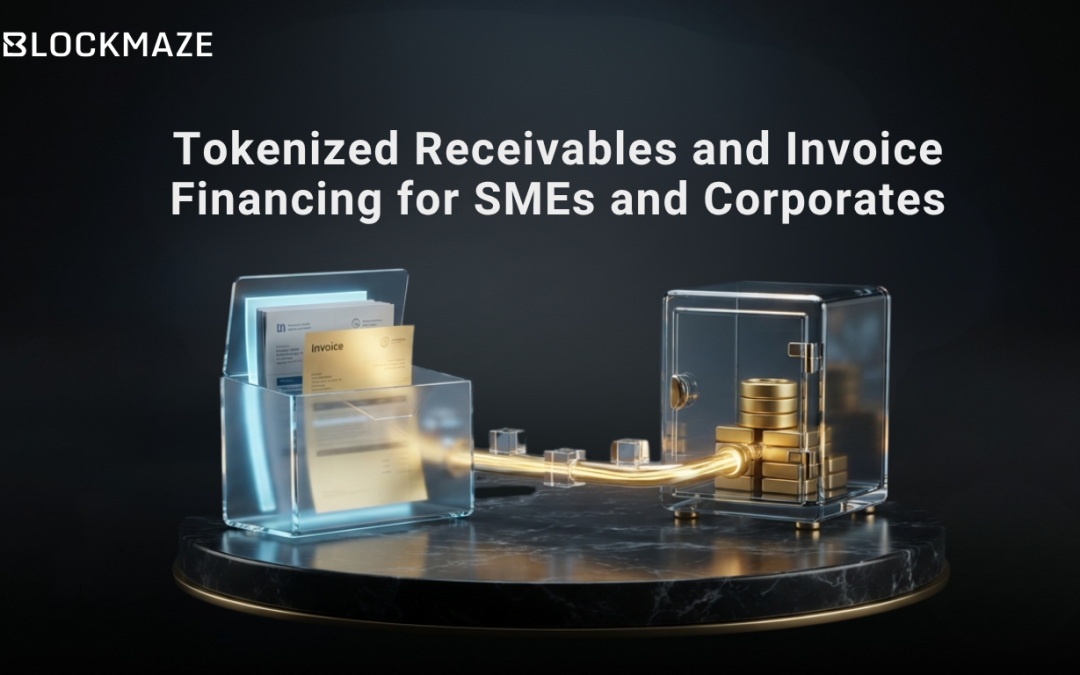
Every business that sells goods or services on credit terms creates a receivable — the legally enforceable right to payment from the buyer at a future date. These receivables collectively represent one of the largest asset classes in the world: global accounts receivable outstanding is estimated at $40+ trillion, representing the deferred payment obligations of every supply chain in every industry globally. The challenge for smaller businesses and emerging market suppliers is that their receivables are illiquid: they must wait 30, 60, or 90 days for buyers to pay, creating working capital gaps that constrain their ability to take on new orders, hire additional staff, or invest in growth. Traditional receivables financing — factoring, invoice discounting, supply chain finance — addresses this need but through bank-intermediated structures that carry credit, relationship, and operational costs that price many SMEs out of the market. Tokenized receivables change the capital structure of receivables financing: by allowing institutional investors to directly purchase tokenized receivable positions, they create a more efficient market that can serve a broader supplier base at lower cost.
How Tokenized Receivables Work
The Basic Mechanics
A supplier holds a validated invoice from a creditworthy buyer a government agency, a large corporation, or any entity with verifiable payment history and credit standing. Rather than waiting for payment, the supplier works with a tokenized receivables platform to: verify the invoice (confirming it is genuine, not previously financed, and represents a real trade obligation); create a token representing the receivable; and sell the token to institutional investors at a discount to face value that reflects the buyer’s credit quality and the time remaining until payment.
At payment date, the buyer pays the face value directly or through the platform. The investor receives the payment recovering their investment plus the discount that constituted their return. The supplier received immediate working capital at the time of token sale. The buyer’s payment obligation is unchanged they pay the same amount on the same date regardless of whether the receivable has been tokenised.
The Credit Quality Equation
For institutional investors, the credit quality question in tokenised receivables is straightforward: the investment grade is the buyer’s credit, not the supplier’s. A receivable from Toyota Motor Corporation is investment-grade regardless of the size of the supplier who issued it. A receivable from a B2B SaaS company is investment grade relative to that company’s credit standing. Tokenisation makes the buyer’s credit quality not the supplier’s the relevant investment analysis, enabling small suppliers with major corporate customers to access working capital at rates reflecting their customers’ creditworthiness rather than their own.
Supply Chain Finance: The Institutional Scale Model
Supply chain finance programmes — where a large buyer sets up a programme enabling its approved supplier base to access early payment — represent the most institutionally scalable receivables tokenization model. In a supply chain finance programme, the buyer confirms which invoices are approved for early payment; suppliers can then access early payment through the programme’s funding mechanism; institutional investors provide the capital that funds early payments, earning the discount between the early payment amount and the face value at maturity.
Tokenised supply chain finance replaces the bank-intermediated funding mechanism with a token-based one: approved invoices are tokenised; institutional investors subscribe to token tranches; the buyer’s payment at maturity settles the token. The buyer’s programme provides the credit quality anchor; the tokenisation provides the distribution mechanism that enables a broader institutional investor base to participate than traditional bank-funded programmes allow.
For institutional investors, supply chain finance tokens are short-duration (30-120 days), high-quality (anchored to large corporate or sovereign credit), and self-liquidating (payment occurs automatically at maturity). This profile — short duration, investment grade, automatic maturity — creates a genuinely attractive institutional fixed income instrument that is difficult to replicate through traditional market access.
Live Market Developments
Figure Technologies: Home Equity Loan Receivables
Figure Technologies has tokenized over $1 billion in home equity loans (HELOCs) on the Provenance blockchain — making it the largest tokenized consumer credit platform in the US. While HELOCs are consumer rather than trade receivables, Figure’s model demonstrates the institutional infrastructure for large-scale receivables tokenization: origination, tokenization, institutional investor distribution, and secondary market trading through Figure’s own ATS. The same infrastructure model is applicable to trade receivables with equivalent legal and credit standing.
AllUnity + Tradeflow + Obligate: Euro Settlement
The February 2026 partnership between AllUnity (Euro stablecoin issuer), Tradeflow (trade finance platform), and Obligate (tokenized securities issuance) integrates a regulated Euro-denominated stablecoin (EURAU) for settling tokenized trade securities. This partnership addresses a specific gap in Euro-denominated trade receivables tokenization: the availability of a regulated digital Euro for settlement without currency conversion friction. For European institutional investors in tokenized trade receivables, EURAU-settled instruments eliminate the EUR/stablecoin conversion cost that USD-settled instruments would impose.
The SME Trade Finance Gap: Why It Matters
The IFC’s $1.7 trillion trade finance gap is disproportionately concentrated in SMEs and emerging market suppliers. Large corporations and multinational companies generally have access to bank trade finance on commercially viable terms — their credit standing, relationship banking networks, and collateral make them bankable. SMEs — particularly those in emerging markets supplying global supply chains — frequently cannot access bank finance at commercially viable rates even when they hold receivables from creditworthy buyers. The mismatch between the SME’s own credit quality (limiting bank access) and the buyer’s credit quality (which determines the actual risk of the receivable) is precisely the gap that tokenised receivables financing closes.
For an Indonesian clothing manufacturer supplying H&M, its own credit standing may be insufficient for bank trade finance, but H&M’s receivables represent investment-grade credit. Tokenised receivables financing uses the buyer’s credit — not the supplier’s — to access institutional capital, potentially closing the working capital gap that currently prevents export-capable SMEs from scaling their supply chain participation.
How Blockmaze Relates to Tokenized Receivables
Blockmaze’s Stocks & Instruments asset category accommodates tokenized receivable instruments structured as debt securities. For GCC-based corporate and institutional issuers — Bahraini trade finance specialists, UAE commodity traders with large receivables books, Saudi corporate supply chain finance programmes — the platform’s institutional distribution capabilities provide access to global institutional fixed income investors seeking short-duration, investment-grade trade receivable exposure.
Disclaimer: This article is for informational purposes only and does not constitute financial or legal advice. Readers should conduct their own research and consult with qualified professionals before making any investment or business decisions.
Frequently Asked Questions
1. What is the global trade finance gap?
The IFC estimates a $1.7 trillion annual gap between demand for trade finance (particularly from SMEs and emerging market suppliers) and available bank supply. Tokenized receivables directly address this gap by enabling institutional investors to fund trade receivables through direct purchase rather than bank intermediation.
2. What determines the credit quality of a tokenized receivable?
The buyer’s credit quality — not the supplier’s. A receivable from an investment-grade buyer (large corporation, government agency) represents investment-grade credit regardless of the supplier’s own credit standing. Tokenisation makes buyer credit quality accessible to institutional investors regardless of the supplier’s own balance sheet.
3. What is supply chain finance?
A programme where a large buyer enables its approved supplier base to access early payment at rates reflecting the buyer’s creditworthiness. Tokenised supply chain finance uses token-based funding in place of bank funding, enabling institutional investors to directly participate in programme financing.
4. How has Figure Technologies applied tokenization to receivables?
Figure Technologies has tokenized over $1 billion in home equity loans on the Provenance blockchain — creating the largest tokenized consumer credit platform in the US and demonstrating the institutional infrastructure model for large-scale receivables tokenization.
5. Are tokenized receivables classified as securities?
Yes, in most jurisdictions. Any token representing a right to future payment from a third party is typically classified as a debt instrument or investment contract — a security subject to registration, disclosure, and investor eligibility requirements. The January 2026 SEC joint statement on tokenized security taxonomies explicitly addresses receivable-type instruments.