
Executive TL;DR
|
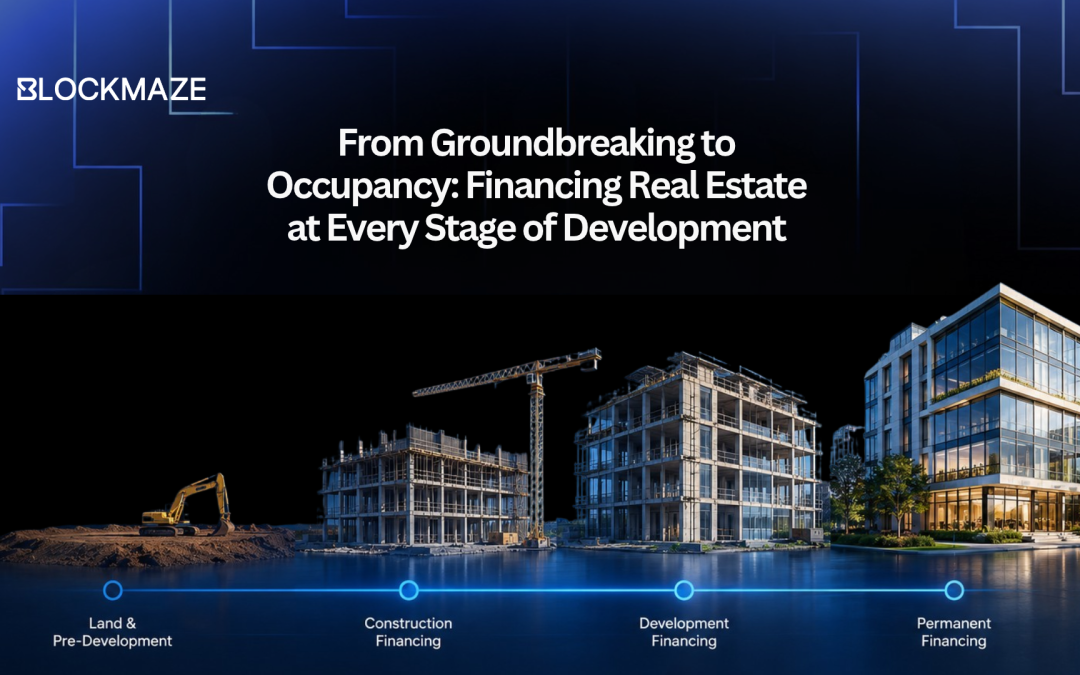
A real estate development project is not financed once it is financed repeatedly, in layers, as the project itself moves through stages that carry fundamentally different risks. Understanding this staged structure in full is what makes clear exactly where the capital formation gaps this series has identified in real estate actually sit, and why a single tokenized instrument covering a project’s entire lifecycle would misrepresent the risk investors are actually taking at any given point.
Stage One: Concept, Feasibility, and Site Selection
Every development begins with a developer testing whether a site can support a proposed project market studies, pro forma modelling, and an assessment of whether the intended use is even feasible on that piece of land. This stage is funded almost exclusively with the sponsor’s own equity, and for good reason: a large percentage of projects never make it past this phase, and no external lender or investor has any basis yet to underwrite a project that may not proceed at all. Site control is often secured through an option or a contingent purchase agreement rather than an outright acquisition, precisely so the developer is not fully committed to land they may ultimately determine cannot support the project.
Stage Two: Pre-Development, Entitlement, and Design
Once a site clears initial feasibility, the project moves into pre-development: securing site control more formally, pursuing zoning approvals and entitlements, and advancing architectural and engineering design to the point where a detailed budget and schedule can be established. This is widely regarded as the stage where projects are most likely to stall entitlement approvals are uncertain and, in many jurisdictions, can take years to resolve, and a project can lose significant value or become entirely unviable if a zoning approval is denied or a community challenge succeeds. Land itself is treated as the riskiest component of the entire capital stack at this stage, since it produces no income and its value depends almost entirely on entitlements that have not yet been secured. Funding at this stage remains primarily sponsor equity or a small circle of early investors, structured with higher return expectations specifically to compensate for this uncertainty; where land loans exist at all, they typically run only 40-60% loan-to-cost and are reserved for sites where entitlements are already substantially in hand.
Stage Three: Financing Structuring the Full Capital Stack
Once entitlements and plans are sufficiently advanced, the developer moves to structure the full capital stack that will actually fund construction. This is where senior construction debt enters: commonly 60-75% of total project cost in 2026, according to current capital stack guidance, disbursed through a draw schedule tied to verified construction milestones rather than released as a single lump sum. Construction lenders underwrite assumptions about the completed project rather than historical cash flow, focusing heavily on sponsor experience, contractor strength, and budget credibility rather than in-place income, since none exists yet.
The gap between senior debt and total project cost is filled by mezzanine debt or preferred equity, typically 15-25% of the stack, and common equity, typically 25-40% layers priced to reflect meaningfully higher risk than the senior construction loan, since they sit behind it in the repayment order established by the project’s cash flow waterfall. Some projects also layer in C-PACE financing for qualifying energy-related scope, subject to the senior lender’s consent.
Stage Four and Five: Procurement and Construction
With the capital stack structured, procurement locks in construction contracts and the baseline budget, and construction itself proceeds under active monitoring: draw requests submitted as milestones are completed, with an independent inspector verifying work before each advance releases. This staged draw process is not a formality it is the primary mechanism by which lenders manage construction risk, ensuring capital is only released against verified progress rather than against a schedule that may not reflect what has actually been built.
Stage Six: Lease-Up, Stabilisation, and the Permanent Takeout
Once construction completes, a project enters lease-up filling the building with tenants or buyers before reaching stabilisation, the point at which income becomes predictable enough to support permanent, lower-cost financing. This is where the permanent takeout loan replaces the construction loan, converting the project from a construction-risk instrument into a stabilised-asset instrument, typically at more favorable terms reflecting the now-verified income stream. The critical, frequently underestimated risk at this stage is timing: developers are advised to arrange a formal takeout commitment before breaking ground whenever possible, because takeout markets change over a construction period that can run several years, and lenders who committed informally at the start of construction may adjust terms materially by the time the project is actually ready for takeout financing. Reporting on recent financing cycles has documented developers caught without secured takeout commitments being forced into discounted sales or costly loan extensions as a direct result.
The Full Stage-by-Stage Picture
Laid out together, the shift in capital source, leverage, and risk across the development lifecycle is the central fact any capital formation approach to real estate has to respect.
| Stage | Typical Capital Source | Typical Leverage | Primary Risk |
|---|---|---|---|
| Concept & feasibility | Sponsor equity only | 0% (all equity) | Project viability itself most projects never proceed past this stage |
| Pre-development & entitlement | Sponsor equity + small circle of early investors; land loans where entitlements are advanced | 40-60% LTC on land, where available | Entitlement uncertainty many projects stall here for years |
| Construction financing | Senior construction loan + mezzanine/preferred equity + common equity | 60-75% LTC (senior); 15-25% mezzanine; 25-40% equity | Construction completion risk, budget and schedule execution |
| Lease-up & stabilisation | Bridging capital or extended construction loan | Similar to construction stage, often at higher pricing | Absorption risk will the project lease up as projected |
| Permanent takeout | Conventional mortgage or institutional permanent loan | Typically lower leverage, priced against stabilised income | Takeout market timing terms can shift materially over a multi-year build |
Why This Staging Matters for Tokenized Capital Formation
Any capital formation structure applied to real estate development has to respect this staged risk profile rather than blending it into a single instrument. This series’ companion analysis of tokenizing finished buildings versus financing projects, and of how developers might raise pre-development capital specifically, both point to the same conclusion this full lifecycle view makes explicit: tokenized capital’s genuine opportunity in real estate sits in matching investors to the specific stage and risk profile they are actually equipped to underwrite, using independently verified milestones entitlement secured, construction phase complete, stabilisation achieved as the basis for both capital release and, potentially, a change in the instrument’s own risk classification as the underlying project itself de-risks.
Frequently Asked Questions
1. What are the main stages of real estate development financing?
Concept and feasibility, pre-development and entitlement, construction financing, procurement and construction execution, lease-up and stabilisation, and permanent takeout financing each stage funded by different capital sources at different leverage and risk levels.
2. How much of a construction loan will a lender typically provide?
Senior construction loans commonly fund 60-75% of total project cost in 2026, disbursed through draws tied to verified construction milestones rather than as a single upfront payment.
3. Why is land and pre-development financing so limited compared to construction financing?
Land produces no income and its value depends entirely on entitlements that may not be secured, making it the riskiest component of the capital stack. Where land loans exist, they typically run only 40-60% loan-to-cost and are reserved for sites where entitlements are already substantially advanced.
4. What is permanent takeout financing and why does timing matter?
It’s the loan that replaces construction debt once a project stabilises, typically at more favourable terms reflecting verified income. Developers who wait until near completion to arrange it risk being caught by market volatility, since takeout market terms can shift materially over a multi-year construction period.
5. Why can’t a single financing instrument cover a real estate project’s entire lifecycle?
Each stage land, entitlement, construction, stabilisation carries a fundamentally different risk profile requiring differently priced capital. Blending them into one instrument would misrepresent the actual risk investors are taking at any given point in the project’s life.
Disclaimer: This article is for informational purposes only and does not constitute financial or legal advice. Readers should conduct their own research and consult with qualified professionals before making any investment or business decisions.