
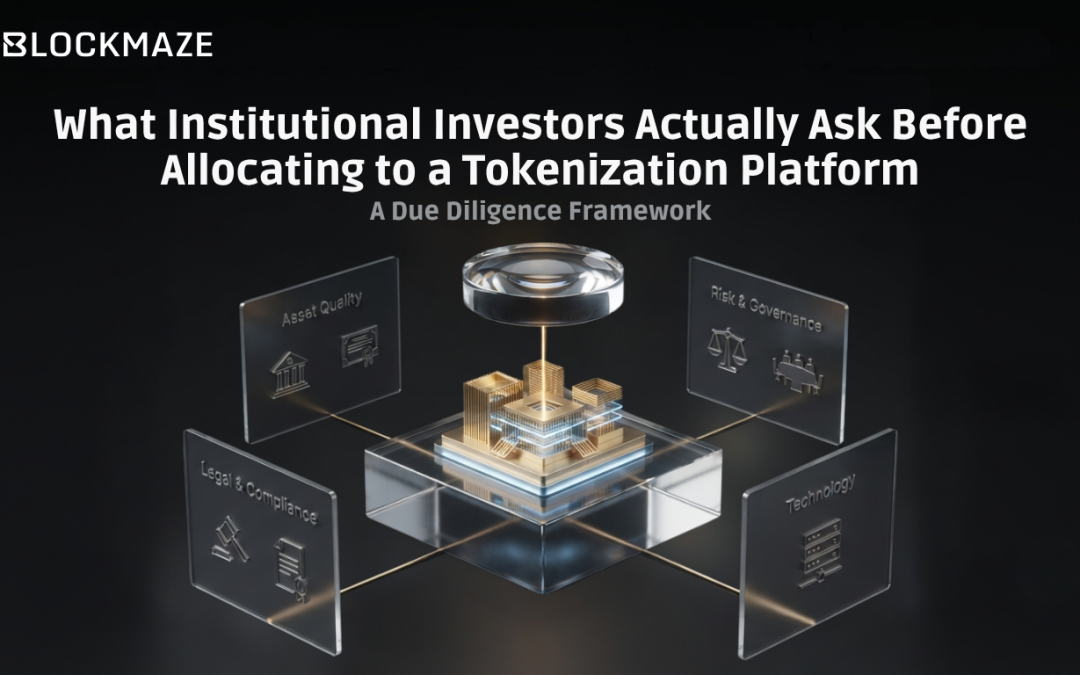
Institutional capital does not move on enthusiasm. Before any meaningful allocation to tokenized infrastructure, an institutional investor a fund, a family office, an insurance company, a corporate treasury runs through a due diligence process that looks remarkably similar whether the underlying instrument is a tokenized bond, a tokenized real estate interest, or a capital formation structure financing a project under development. Understanding what institutions actually ask, in the order they actually ask it, is more useful to both issuers and evaluators than any list of blockchain features.
Category 1: Regulatory Standing
This is always the first question, and it is rarely phrased subtly. What licences does the platform or its operating entities hold, in which jurisdictions, and do those licences actually cover the specific activity the institution intends to engage in issuance, custody, distribution, or secondary trading? Institutions distinguish sharply between a platform operating under genuine regulatory authorisation and one operating in a jurisdiction chosen for its absence of oversight. A platform’s regulatory footprint the specific jurisdictions, the specific licence categories, and how recently those licences were obtained and renewed is typically the first document an institutional compliance team requests.
Sub-questions institutions typically raise:
- Which specific regulator issued each licence, and what is the scope of activity it authorises?
- Does the platform’s compliance infrastructure enforce these regulatory requirements at the transaction level, or is compliance a manual, after-the-fact process?
- What happens if the platform’s regulatory status changes in a jurisdiction where the institution has active exposure?
Category 2: Technical Architecture and Security
Once regulatory standing is established, institutional technical teams evaluate the infrastructure itself. Has the smart contract architecture been independently audited, by which firms, and what were the findings? What is the validator set’s composition and governance who controls it- and what accountability mechanisms exist if a validator behaves improperly? What is the disaster recovery and business continuity plan if core infrastructure fails?
Sub-questions institutions typically raise:
- Which independent firms have audited the smart contract infrastructure, and are the audit reports available for review?
- What is the multi-signature or governance threshold for any action that could move or affect institutional assets?
- How does the network handle a validator failure or malicious actor without disrupting institutional positions?
Category 3: Governance and Control
This category has grown in importance as institutions move from evaluating single-asset tokenization toward evaluating capital formation structures that persist over years. Who governs decisions after an initial capital raise is complete? What voting rights or oversight does an institutional investor retain, and how does that compare to the rights an anchor investor holds? Can the platform operator unilaterally change terms after an institution has committed capital?
Sub-questions institutions typically raise:
- What is the DAO or governance structure’s decision-making process, and how are institutional participants represented within it?
- What is the process for resolving a dispute between the project sponsor, the anchor investor, and smaller co-investors?
- Can governance parameters be changed after an institution has committed capital, and if so, under what process and with what notice?
Category 4: Capital Formation and Project Financing Mechanics
This is the newest and fastest-growing category of institutional due diligence question, specific to capital formation structures that finance projects rather than represent finished assets. Institutions evaluating this kind of exposure ask fundamentally different questions than they ask about tokenized bonds or funds.
Sub-questions institutions typically raise:
- How is capital released to a project sponsor in a single tranche, or against verified milestones?
- Who independently verifies that a milestone has been achieved before the next tranche of capital releases?
- What are the rights of a smaller institutional co-investor relative to an anchor investor if the project underperforms, is delayed, or requires restructuring?
- What happens to committed but undeployed capital if a project fails to reach a required capital threshold within a defined timeframe?
- Is there a defined process for exit — secondary liquidity, redemption, or wind-down if an institution needs to reduce its position before project completion?
Category 5: Production Evidence, Not Pilot Announcements
Institutional evaluators in 2026 are notably more skeptical of pilot and partnership announcements than they were even two years earlier. The standard institutions increasingly apply is commercial usage and connected liquidity actual transaction volume, actual assets under management, actual completed capital formation cycles rather than the volume of press releases a platform has generated. An institution will typically ask for verifiable production metrics rather than accepting stated ambitions.
Sub-questions institutions typically raise:
- What is the platform’s actual assets under management or total value processed, independently verifiable rather than self-reported?
- How many capital formation cycles has the platform actually completed, from initial raise through to capital deployment or project completion?
- Can the platform provide references from institutions that have already completed a full cycle — not just initiated one?
Frequently Asked Questions
What is the first question institutional investors ask about tokenized infrastructure?
Regulatory standing: which specific licences does the platform hold, in which jurisdictions, and do those licences cover the specific activity the institution intends to engage in. This precedes any technical or governance evaluation.
How does due diligence differ for capital formation structures versus asset tokenization?
Capital formation due diligence adds questions about milestone-based capital release, independent verification of project progress, the relative rights of anchor investors versus smaller co-investors, and exit mechanisms before project completion — none of which apply to tokenizing an already-finished asset.
Why do institutions distinguish between pilot announcements and production evidence?
Institutions have observed a pattern of announced partnerships and pilots that do not convert to sustained production usage. The standard institutions now apply is verifiable commercial volume, connected liquidity, and completed capital formation cycles rather than the number of announcements a platform has made.
What governance questions matter most for multi-year capital formation projects?
Who governs decisions after the initial raise, what rights smaller co-investors hold relative to an anchor investor, how disputes are resolved, and whether governance parameters can change after capital has been committed — all of which matter more for a multi-year project than for a single-transaction asset tokenization.
What happens if a project financed through tokenized infrastructure fails to complete?
This is now a standard institutional due diligence question. Serious evaluators require a defined framework for what happens to committed capital, what recourse investors have, and how any partially completed project is unwound or restructured — addressed before capital commitment, not after a problem arises.