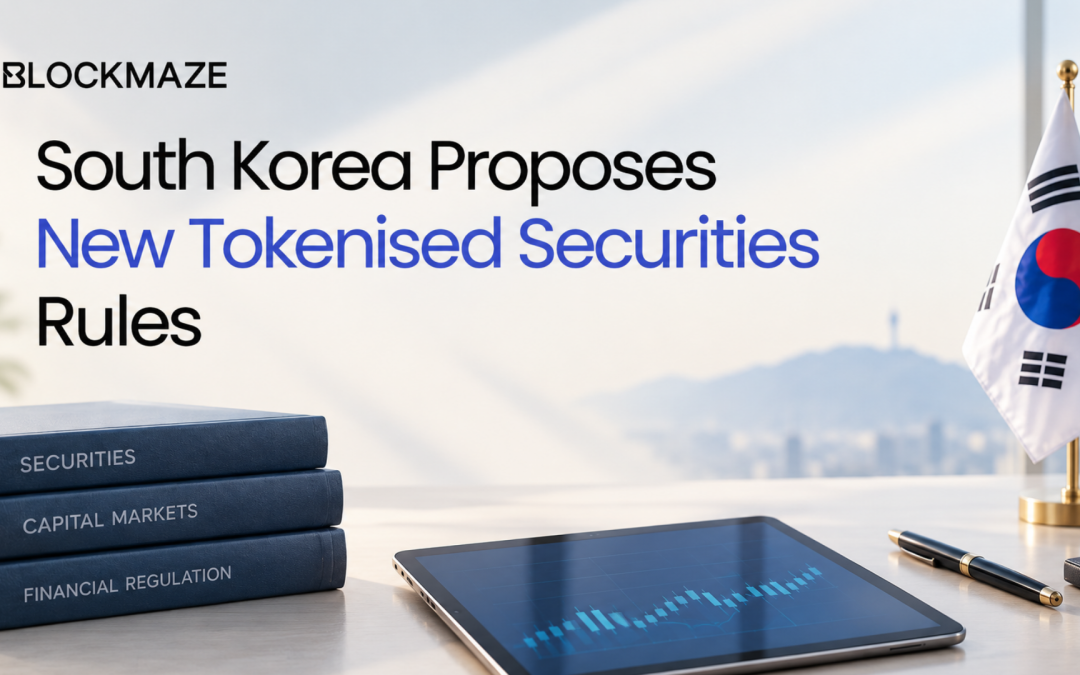
South Korea’s Financial Services Commission (FSC) has released the detailed rules for trading tokens on the stock and bond markets from February 2027. These rules are part of the amendments to the Financial Investment Services and Capital Markets Act and the Act on Electronic Registration of Stocks and Bonds. These amendments go into effect on February 4th, 2027. The detailed rules were published for public comment on October 2, 2026 and the comment period is open until November 11, 2026.
The main decision is conceptual. Korea is not creating a new class of crypto asset. Security tokens are in digital form of traditional securities, and hence, are subject to the same rules and regulations that apply to the traditional securities.
What the rules cover
Until now, the discussion on security tokens in Korea centered around fractional investment products such as shares of music or art royalties. The draft rules have expanded the discussion to the full spectrum of investment products including lower risk and more institutional investments, as outlined in the FSC’s three-stage road map published on September 4, 2022.
| Stage | Scope | Timing |
|---|---|---|
| Stage 1 | Privately placed money market funds, bonds sold only to institutions, unlisted shares issued through a trust structure, and publicly offered fractional investment securities | From 4 February 2027 |
| Stage 2 | Publicly offered securities more generally | Not set |
| Stage 3 | On-chain settlement linked to stablecoins | Not set; depends on Stage 1 results and separate stablecoin legislation |
Who keeps the register?
The main point in the report concerns the ownership record. For electronic registration to be valid, the ledger must be accessible to at least two account-management institutions and to the Korea Securities Depository (KSD), the country’s central securities depository. If the ledger is not accessible to all of the above, it will not be considered a valid ownership record. Charging a fee for use of the ledger is not permitted. It has been reported that the ledger must be freely accessible, because the function of the ledger is to serve the public, and interruptions in the confirmation of ownership are not permitted. The KSD has developed screening criteria, including business-continuity requirements, for firms that want to interconnect their ledgers.
Firms wishing to manage customer accounts would need a minimum equity capital of approximately KRW 4 billion, one account management specialist, one internal control specialist, and two IT specialists, and would have to meet technology and cybersecurity standards.
Licensing and retail limits
Firms wishing to engage in tokenized investment businesses would also need a licence to engage in an over-the-counter (OTC) market, whereas an OTC licence for tokenized investment businesses would be standalone. No standalone licence for tokenized securities is planned. Tokenized versions of investments already permitted to firms would require prior consultation with the Financial Supervisory Service, if firm wishes to intermediated such transactions. The drafts add a licence for OTC dealing in debt securities, alongside existing categories for OTC dealing of unlisted equities and non-monetary trust beneficiary certificates.
Retail subscription limits would apply to tokenized investments, with the cap set at the lower of 5% of the issue and KRW 30 million per retail investor for tokenized investments.
Why the Korean approach is significant
Most jurisdictions experiment with tokenization through sandboxes and pilots. In the case of India, the first tokenized corporate bonds, i.e. ₹500 crores issued by REC in September, were issued under SEBI’s regulatory sandbox. The Korean approach is to incorporate the regulatory framework for tokenized securities into their primary securities laws, addressing the unanswered questions left by pilots. It stipulates where legal ownership is recorded, who can keep the register, the capital and staffing requirements of an account manager, and how much a retail investor can purchase.
As with any policy initiative, there are trade-offs. Considering tokens as securities helps allay some of the concerns of investors, but at the same time, it anchors tokenization to the existing licensing perimeter and KSD’s central role, thus limiting how far tokenized markets can stray from today’s structures. The FSC has taken an incremental approach and limited retail purchases for the first phase.
There is strong preference in the market for shared, verifiable registers (as opposed to issuer-controlled ledgers). Blockmaze, which is unrelated to the Korean framework, takes this into account at the protocol level. It has an issuer registry on-chain, verifies identities and legal authorizations of issuers, and maintains settlement and governance functions separately.
What to watch
The consultation period ends on November 11. After that, the various drafts still need final approval before the February 4 launch. A number of features of the framework, including the retail cap, the 4 billion KRW capital requirement, and the requirement to share ledgers, are likely to change as a result of feedback. Progress on stablecoin legislation and third-party market updates will provide insight into how far Korea is willing to extend beyond institutional products.
Sources
The Korea Times, 1 October 2026; Crowdfund Insider, 3 October 2026; CoinReporter and CoinPaprika, 2 October 2026 (citing the FSC press release and Yonhap); Business Standard on REC’s tokenised bond, September 2026; blockmaze.org.
Disclaimer: This article is for informational purposes only and does not constitute financial or legal advice. Readers should conduct their own research and consult with qualified professionals before making any investment or business decisions.