
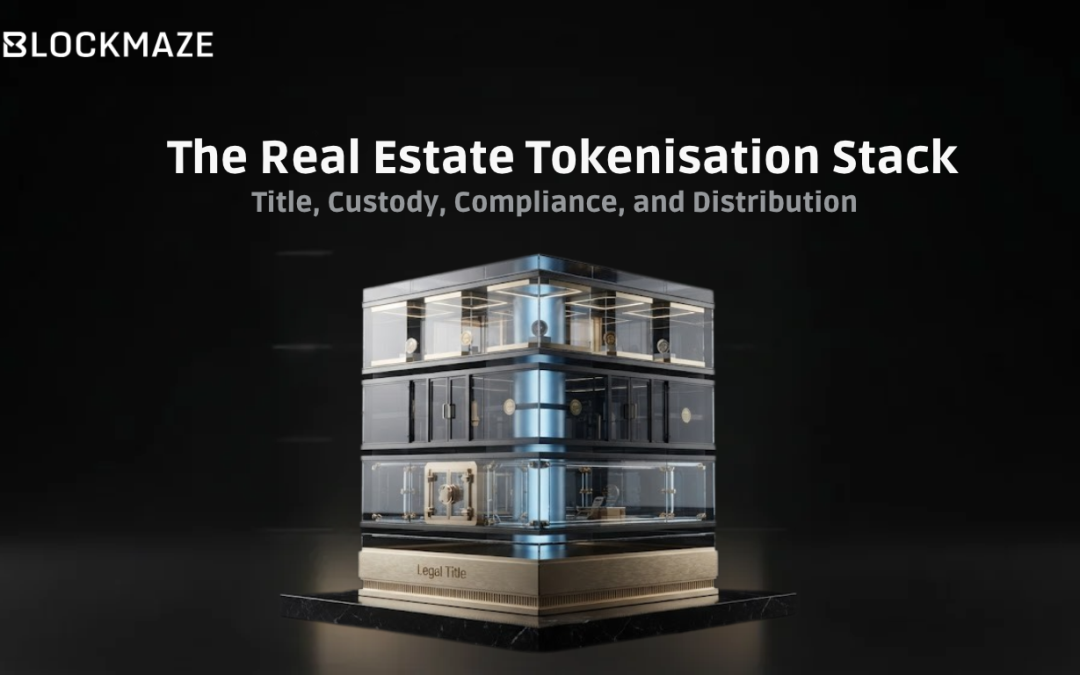
Executive TL;DR• Tokenised real estate is not a single infrastructure decision it is a stack of four distinct layers, each with its own technical and legal requirements, and each capable of independently causing a project to fail even if the other three are correctly built. Most retail tokenised real estate failures of 2022-2026 failed at Layer 1 (title) and Layer 3 (compliance), not at the token technology layer. • Layer 1 — Title: the foundational question of how the token connects to legal ownership of the property. Three models exist: entity-ownership (token represents interest in a property-owning LLC most common but creates operator risk), beneficial title (token evidences a trust beneficiary interest in the property), and direct title registration (token transfer recorded in government land registry the model Dubai adopted in 2025). Only the third model fully solves the legal title problem. • Layer 2 — Custody: who holds the underlying property interest, how it is segregated from operator assets, and what happens to the property in an operator insolvency. SPV isolation, independent director requirements, and ring-fencing provisions are the mechanisms here legal arrangements that are more important to investor protection than any blockchain feature. • Layer 3 — Compliance: investor eligibility enforcement, regulatory classification of the token instrument, ongoing reporting obligations, and the AML/CTF framework for international investors. The RealT failure involved US regulatory constraints that blocked US persons from investing and created an almost entirely non-US investor base without adequate legal protections in their home jurisdictions. • Layer 4 — Distribution: secondary market infrastructure, liquidity venues, price discovery mechanisms, and the market-making or automated market maker frameworks that allow token holders to exit without waiting for the platform to arrange a bilateral sale. Without this layer, tokenised real estate remains illiquid regardless of how technically sophisticated the token is. |
The tokenised real estate failures of 2022-2026 were not, in most cases, failures of the token technology. Ethereum processed the transactions correctly; the smart contracts distributed income accurately (until distributions stopped); the wallets held the tokens as recorded. What failed was the stack of infrastructure underneath the token the legal title structure, the asset custody and segregation arrangement, the compliance framework for international investors, and the secondary market infrastructure that would have allowed investors to exit before problems became catastrophic.
Layer 1: Title The Foundation Everything Else Depends On
The Three Title Models
| Title Model | How It Works | Investor’s Legal Position | Key Risk |
|---|---|---|---|
| Entity ownership | Token represents membership interest in a property-owning LLC or similar entity | Contractual claim against the entity; not a direct property title holder | Operator risk entity can be managed badly, incur debt, or face legal action that threatens the property |
| Beneficial title (trust) | Token evidences beneficial interest in a trust that holds title to the property | Beneficiary of a trust; stronger than entity ownership, trust assets segregated from trustee’s personal assets | Trust administration complexity; jurisdiction-specific trust law applies |
| Direct title registration | Token transfer recorded in government land registry; ownership recorded at the title level | Direct title interest recorded in official government records strongest possible legal position | Requires government system integration; only available in jurisdictions with digital title infrastructure (currently Dubai, limited others) |
The Dubai Land Department’s Prypco Mint launched in May 2025 is the clearest current implementation of the direct title registration model the only model that fully solves the legal title problem by connecting the on-chain record to the government record. In jurisdictions where this is not available, entity-ownership structures can be made safer through careful SPV design, independent director requirements, and defined ring-fencing provisions but they cannot be made equivalent to a direct title registration.
Layer 2: Custody What Happens to the Property if the Operator Fails
‘Custody’ in tokenised real estate means something more specific than in financial asset custody: it refers to the legal segregation of the underlying property interest from the operator’s general estate, such that an operator insolvency does not take the property down with it.
SPV Isolation
The most commonly used mechanism is a Special Purpose Vehicle: a property-specific LLC or trust whose only asset is the specific property (or properties) associated with that token series. The SPV should have limited purpose no activities beyond holding the specific property and should be structurally insulated from the operator’s other business activities, debts, and legal obligations.
RealT’s corporate structure involved 165+ affiliated corporate defendants named in the Detroit city lawsuit. The number of entities suggests a complex web of interrelated vehicles rather than clean SPV isolation a structure that provides less protection than a genuine ring-fencing arrangement and makes investor recourse more complex in exactly the circumstances where recourse is most needed.
Independent Director Requirements
A property-holding SPV managed entirely by the operator’s management has limited independence in an insolvency scenario. Independent director provisions requiring at least one director who is not an employee or officer of the operator, with explicit blocking rights over insolvency-related decisions provide a structural check that protects the property and its investors when the operator’s interests and investors’ interests diverge.
Layer 3: Compliance Regulatory Classification and Investor Protection
Securities Law Classification
In the US, tokens representing equity interests in property-owning entities are securities under the Howey Test which means that platforms distributing them to investors must register the offering (prohibitively expensive for retail real estate tokenisation) or rely on exemptions (Regulation D for accredited investors; Regulation S for offshore investors). Most retail tokenised real estate platforms used Regulation S for international investors, which excludes US persons from purchasing but does not guarantee that non-US investors receive equivalent protections under their own jurisdictions’ laws.
The approximately 400 French investors now pursuing class action against RealT illustrate the specific compliance failure: French investor protection law may give investors claims that US-focused platforms did not design their compliance frameworks to accommodate. International investor bases require jurisdiction-specific legal analysis for each significant investor country an obligation that many first-wave platforms treated as a boilerplate legal review rather than a genuine multi-jurisdiction compliance design.
AML/CTF for International Investors
Tokenised real estate platforms serving international investors particularly for assets located in the US but funded by European, Asian, or Middle Eastern investors face AML/CTF obligations in multiple jurisdictions simultaneously. A French investor purchasing a Regulation S interest in a Detroit property LLC triggers AML/CTF considerations under French law and EU regulations, in addition to any applicable US obligations. Platforms that designed AML/CTF compliance primarily around US framework requirements without equivalent consideration of investor home jurisdictions created structural compliance gaps.
Layer 4: Distribution The Exit Infrastructure That Most Platforms Did Not Build
Secondary market liquidity for tokenised real estate requires explicit infrastructure: a venue where token holders can offer their positions for sale, a mechanism for buyers to find and evaluate offers, price discovery infrastructure, and either market makers or automated market mechanisms that provide liquidity without requiring bilateral matching of every trade.
Most first-wave tokenised real estate platforms built primary issuance infrastructure (a way to buy tokens in initial offerings) but not secondary market infrastructure. The implicit assumption was that peer-to-peer transfers would create a liquid market. They did not because peer-to-peer transfer capability is necessary but not sufficient for a liquid secondary market. Without visible order books, market makers, and adequate trading volume to enable price discovery, tokenised real estate positions were effectively illiquid despite being technically transferable.
The Dubai model’s AED 2,000 minimum ($540) compared to the $10,000+ minimums of many US platforms is one structural improvement that could support a larger investor pool. But even a large investor pool does not automatically create secondary market depth without explicit market-making infrastructure or automated market mechanisms.
The Full Stack Requirement
- Title layer: direct government title registration where available (Dubai); entity-ownership with clean SPV isolation, independent directors, and ring-fencing elsewhere
- Custody layer: property-specific SPVs with limited purpose, structural insulation from operator estate, and independent director blocking rights on insolvency decisions
- Compliance layer: jurisdiction-specific securities law analysis for each significant investor country; AML/CTF framework for international investor home jurisdictions; ongoing reporting obligations in each jurisdiction
- Distribution layer: secondary market venue with visible order books; market-making provision or AMM mechanism; price discovery infrastructure; explicit investor exit provisions
A project that correctly implements all four layers is meaningfully safer and more functional than one that only implements the token technology. The RealT failure had a correctly functioning blockchain layer and three largely absent lower layers. The lesson for any institutional participant evaluating a tokenised real estate investment is straightforward: ask specific questions about each layer, not about the token standard.
Frequently Asked Questions
1. What is the strongest title model for tokenised real estate?
Direct title registration where token transfers are recorded in government land registry records is the strongest model because it connects the digital record directly to the legal title record. Dubai’s Prypco Mint (launched May 2025) is the clearest current implementation. Entity-ownership models can be made safer through SPV isolation and independent director provisions but do not achieve the same legal clarity.
2. What is SPV isolation and why does it matter?
A Special Purpose Vehicle with limited purpose (holding only the specific property) and structural insulation from the operator’s other business activities. In an operator insolvency, properly isolated SPVs can protect the property and investors’ interests; improperly structured SPVs become part of the general insolvency estate. RealT’s 165+ interrelated affiliated entities suggest limited SPV isolation relative to best practice.
3. Why did international investor protection become a specific issue in the RealT collapse?
French investors (approximately 400) are pursuing class action under French law, and a criminal complaint has been filed in Paris. US platforms using Regulation S to offer to non-US investors must design compliance frameworks that accommodate investor protection obligations in each significant investor home jurisdiction an obligation many platforms treated inadequately.
4. What secondary market infrastructure do tokenised real estate platforms need?
Visible order books, market-making provisions or AMM mechanisms, adequate trading volume for price discovery, and defined investor exit provisions. Peer-to-peer transfer capability is necessary but not sufficient without active market-making or automated liquidity provision, tokenised positions remain illiquid despite being technically transferable.
Disclaimer: This article is for informational purposes only and does not constitute financial or legal advice. Readers should conduct their own research and consult with qualified professionals before making any investment or business decisions.