
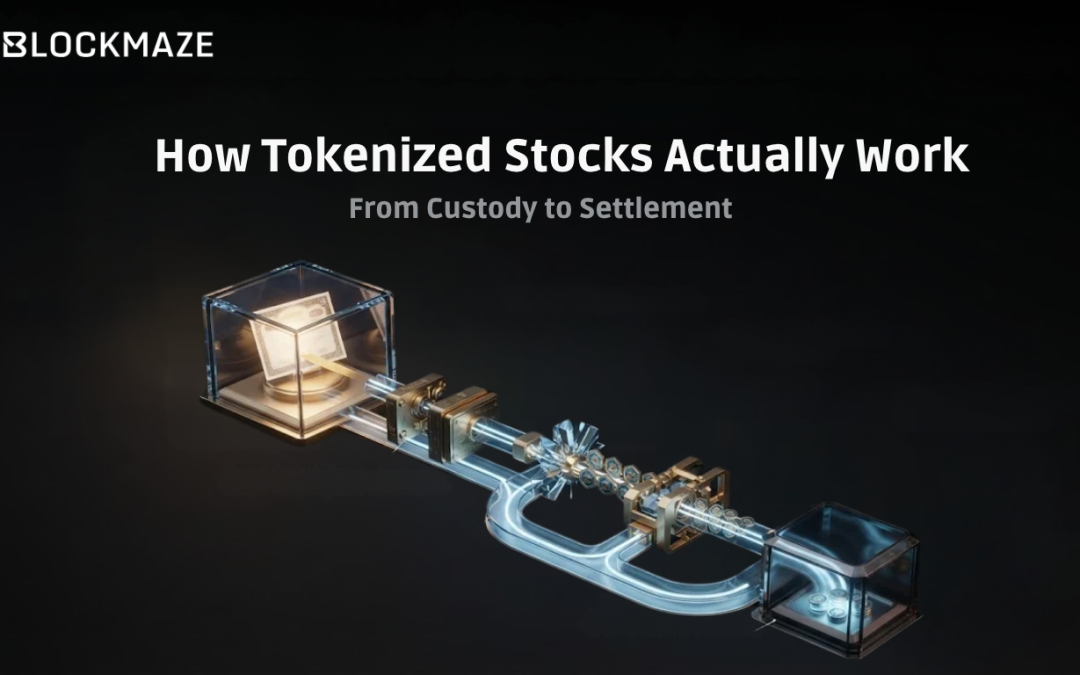
Executive TL;DR• A tokenized stock is a digital token that represents economic exposure to an underlying share. The critical distinction: spot tokenized stocks (like Binance bStocks, Ondo xStocks, Kraken xStocks) are backed 1:1 by actual shares held in regulated custody. Perpetual contracts that track equity prices through oracle feeds without holding underlying shares are fundamentally different instruments with different risk profiles. • The operational chain for a spot tokenized stock: the issuer holds the underlying shares through a regulated broker-dealer or custodian; the custodian verifies the share holding; the issuer mints an equivalent number of tokens on a blockchain; eligible investors receive tokens through a compliant distribution; and corporate actions (dividends, splits) are applied to token holders based on their holdings at record date. • The transfer restriction mechanism: a smart contract checks whether the receiving wallet is on the issuer’s allowlist before any transfer executes. The allowlist contains only wallets whose owners have completed KYC verification. This is the technical mechanism that makes tokenized stocks securities-compliant rather than permissionless crypto tokens. • Settlement mechanics: a peer-to-peer token transfer between two on-chain wallets can settle in seconds or minutes depending on the network. The economic settlement — payment for the transferred tokens — may still involve traditional payment rails unless both the asset and the payment are tokenized and can settle atomically. • The DTCC’s July 15, 2026 production settlement of tokenized US securities demonstrated the endgame: a Tokenized Entitlement mirroring an existing DTCC book-entry position, allowing on-chain mobility while the official register remains authoritative. Cede & Co. remains the registered owner; the token enables the on-chain representation. |
Most descriptions of tokenized stocks focus on what they enable 24/7 trading, fractional ownership, borderless access without explaining how they actually work. The operational chain between an investor clicking ‘buy’ on a tokenized stock platform and that token arriving in their wallet involves regulatory screening, custodial verification, token minting, compliance-enforced transfer, and settlement mechanics that are materially more complex than the marketing language around tokenized equities typically acknowledges. Understanding this chain is what separates an investor who knows what they own from one who does not.
Step 1: The Custodial Layer Where the Shares Actually Are
Every spot tokenized stock Binance bStocks (issued by BTech Holdings Limited, a Binance affiliate), Backed Finance’s xStocks (used by Kraken), Ondo Global Markets equities is backed by actual shares of the underlying company held by a regulated custodian or broker-dealer. The shares physically exist as book-entry positions in traditional securities infrastructure the DTC in the US, Euroclear or Clearstream in Europe held by a custodian who is the beneficial owner on record.
The custodial arrangement is the foundational claim of spot tokeniztokened equity: that the token is redeemable for the underlying share (or its cash equivalent) and that the economic rights of the share dividends, splits, potentially voting rights depending on the issuer’s terms flow through to the token holder. Without a verifiable custodial arrangement that an independent auditor or proof-of-reserve mechanism can confirm, a token claiming to be ‘backed 1:1’ by a share is making an unverifiable assertion.
Step 2: Token Minting Creating the On-Chain Representation
Once the underlying shares are in custody, the issuer mints an equivalent number of tokens on the target blockchain BNB Chain for bStocks, Solana or Ethereum for various others. The minting is typically controlled by a smart contract that only the issuer can call, with the token quantity matching the share quantity held in custody at any given time.
The token standard matters here. ERC-20 tokens on Ethereum are permissionless any wallet can receive them. Security-compliant tokenized stocks use standards like ERC-3643 (for Ethereum-compatible networks) that build compliance enforcement into the token itself. A wallet not on the issuer’s allowlist cannot receive the token, regardless of what transfer is attempted.
Step 3: Investor Onboarding The Compliance Gate
Before an investor can buy or hold a tokenized stock, the issuer or its compliance provider runs KYC/AML screening on the investor’s identity. This typically involves identity document verification, sanctions screening, and investor classification (retail vs institutional, jurisdiction eligibility). For jurisdictions where the issuer does not have regulatory authorisation to offer the product most tokenized equity issuers exclude US residents, for example the compliance gate must prevent those investors from subscribing.
Once an investor passes screening, their wallet address is added to the allowlist maintained by the transfer agent or compliance provider. The smart contract will then permit transfers to and from that wallet. If the investor fails the screening, or if their eligibility status changes (sanctions hit, residency change to a restricted jurisdiction), their wallet can be removed from the allowlist and future transfers to that address will fail automatically.
Step 4: Trading and Transfer What 24/7 Actually Means
A tokenized stock that is on the allowlist of an investor can be transferred peer-to-peer at any time including weekends, after hours, and across time zones. This is the genuine 24/7 property: the smart contract does not know or care what time it is. Binance recorded $2 billion in bStocks trading volume over a single weekend, and after US market hours bStocks account for 58% of equity-linked trading volume on the platform.
The settlement of the transfer the delivery of the token against payment depends on the payment method. If payment is in a stablecoin (USDT, USDC) that settles on-chain, the token and the payment can settle atomically in a single transaction. If payment is in fiat through traditional rails, the settlement has the latency of those rails typically T+1 in most markets. True atomic settlement requires both legs of the transaction to be on-chain.
Step 5: Corporate Actions The Hardest Part
When the underlying company declares a dividend, executes a stock split, or undergoes a merger, the tokenized stock must correctly apply the corporate action to token holders. This is operationally more complex than it appears.
For a cash dividend: the issuer identifies token holders at the record date (the specific block or timestamp that serves as the record snapshot), calculates each holder’s entitlement, and distributes payment typically in stablecoins rather than fiat, since direct fiat distribution to token wallets is not straightforward. For a stock split: additional tokens must be minted in proportion to each holder’s position. For a merger where the underlying company is acquired: the original tokens must be retired and holders must receive the acquisition consideration, which may not be a tokenized instrument.
This last scenario the corporate action that retires the instrument is where most tokenized equity infrastructure has the least defined behaviour, and institutional participants should ask specifically how the issuer handles this scenario before committing significant capital to a tokenized equity position.
Step 6: Settlement Infrastructure The DTCC Model
The DTCC’s July 15, 2026 production settlement of tokenized US securities provides the most authoritative illustration of how the endgame settlement model works. In the DTCC’s Tokenized Entitlement model: a DTC Participant requests conversion of a traditional book-entry position to a blockchain-based token. The DTCC immobilises the underlying entitlement into a Digital Omnibus Account, mints a token via its Factory system, and delivers the token to the Participant’s Registered Wallet.
Cede & Co. the DTCC’s nominee entity remains the registered owner on the issuer’s official register. The token is a Tokenized Entitlement that mirrors the book-entry position, not a replacement for it. If the blockchain and the official register disagree, the register wins. This hybrid model is the near-term standard: blockchain adds on-chain mobility and composability to settlement infrastructure that remains anchored to existing legal ownership records.
Frequently Asked Questions
1. What’s the difference between a spot tokenized stock and an equity perpetual?
A spot tokenized stock is backed 1:1 by an actual share held in regulated custody the token holder has economic exposure equivalent to share ownership. An equity perpetual tracks the share price through oracle feeds and a funding rate mechanism without any underlying share being held. Spot tokens are regulated securities; equity perpetuals are derivatives with different risk, regulatory, and accounting profiles.
2. How is a tokenized stock’s 24/7 trading property enabled?
Smart contracts do not have business hours a wallet transfer executes whenever it is submitted and processed, regardless of the time. Payment settlement depends on whether the payment leg is also on-chain (stablecoin for atomic settlement) or traditional fiat rails (T+1 or similar latency). True 24/7 atomic settlement requires both the asset and the payment to be on-chain.
3. What happens if a tokenized stock issuer fails?
The shares held in custody are the ultimate backing if the issuer fails, the custodian holds the underlying shares. The practical question is whether the insolvency process correctly connects token holders to their custodial entitlements. This depends entirely on how the legal structure isolates the custodial holding from the issuer’s operating entity which is why the legal opinion on this structure is one of the most important due diligence documents in tokenized equity evaluation.
4. What is the DTCC’s Tokenized Entitlement model?
The DTCC immobilises a traditional book-entry entitlement into a Digital Omnibus Account, mints a corresponding token, and delivers it to the holder’s registered wallet. The underlying book-entry position remains owned by Cede & Co. on the issuer’s official register. The token enables on-chain mobility; the register remains the source of legal ownership.
Blockmaze and the Operational Chain
Each step in the tokenised securities operational chain — custodial verification, token minting, KYC compliance gate, 24/7 transfer, corporate action processing, and settlement — maps directly to infrastructure Blockmaze provides at the network level. Identity-verified allowlists enforce the KYC gate: a wallet that has not cleared eligibility cannot receive a token, regardless of what transfer is attempted. Proof of Reserve attestation every fifteen days provides continuous custodial verification — independent confirmation that outstanding tokens correspond to real underlying assets. DAO governance provides the supervised process for handling corporate action types the smart contract has no predefined behaviour for. And the compliance-enforced transfer restrictions that make every transfer check eligibility before executing apply the same logic at settlement that the DTCC’s Tokenised Entitlement model applies at the institutional level. The operational chain works because the infrastructure under each step is built to handle it.
Disclaimer: This article is for informational purposes only and does not constitute financial or legal advice. Readers should conduct their own research and consult with qualified professionals before making any investment or business decisions.