
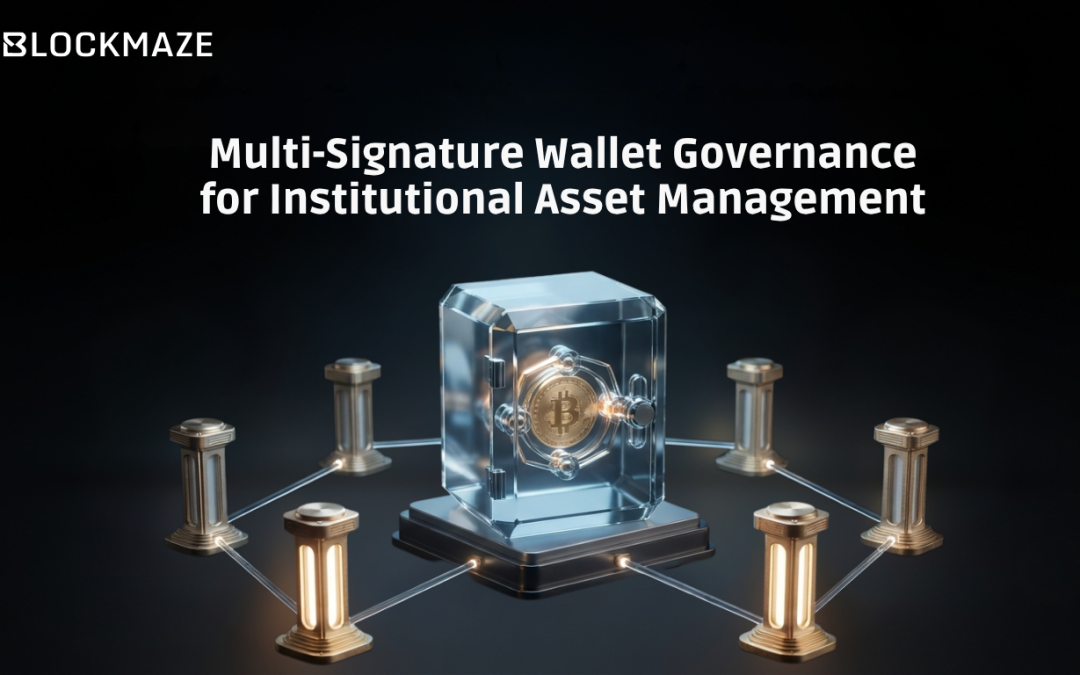
A multi-signature wallet is a smart contract-based wallet that requires a defined number of authorised signatories to approve any transaction before it executes. Where a standard single-key wallet requires one private key signature to move funds, a multi-sig wallet might require 3 of 5 designated signatories, or 4 of 7, or 2 of 3 the threshold is set by the wallet’s configuration and can be tailored to the specific governance requirements of the institution using it. For institutional asset management in the tokenized assets era, multi-sig wallets are the primary mechanism for implementing the distributed authority controls that institutional governance frameworks require.
Why Multi-Sig Matters for Institutional Digital Asset Governance
The Single Point of Failure Problem
A single-key wallet creates a single point of failure: whoever controls the private key controls all assets in the wallet. This is an obvious risk key theft, key loss, or key holder compromise eliminates the institution’s ability to access and manage its digital assets. But it is also a governance problem: a single key holder makes all decisions unilaterally, without the review and approval procedures that institutional governance frameworks require for significant transactions.
Multi-sig as Internal Control
For institutional governance purposes, multi-sig wallets are the blockchain-native equivalent of dual-control financial controls in traditional banking: the same principle that requires two senior authorisations for large wire transfers, or two trading desk approvals for position-limit-exceeding trades. Institutional governance frameworks that specify segregation of duties for financial transactions have a direct mapping to multi-sig requirements: no single individual should be able to move significant institutional assets without the concurrent approval of at least one independent reviewer.
Regulatory Expectation
Regulated financial institutions holding digital assets are expected to implement custody controls equivalent to those applied to traditional assets. Multi-sig controls requiring multiple independent parties to authorise transactions are the digital asset equivalent of the dual-control, joint-custodian standards that financial regulators expect for significant asset movements. OCC-chartered digital asset custodians (Anchorage, BitGo) implement multi-sig or MPC equivalents as core custody architecture rather than optional features.
Safe: The Institutional Standard
Safe, formerly known as Gnosis Safe, is the dominant institutional multi-sig wallet infrastructure globally. With over $100 billion in assets secured and deployment across the majority of institutional DeFi protocols, DAO treasuries, and digital asset custodians, Safe has established itself as the institutional standard for multi-sig governance. Its open-source, extensively audited codebase is a governance quality signal: institutions can independently verify the wallet’s code rather than trusting a proprietary implementation.
Safe’s ecosystem includes: Safe Apps (a marketplace of applications that integrate with the Safe wallet interface), Safe Transaction Service (an off-chain service for managing transaction proposals and approvals), and Safe{Core} (the protocol layer that Smart Account infrastructure can build on). For institutional implementations, Safe’s compatibility with Ethereum-native tokenized securities and its broad integration with custody and DeFi infrastructure makes it the lowest-friction choice for institutional multi-sig governance.
The Bybit Lesson: Signing Ceremony Security
The Bybit February 2025 hack — $1.5 billion, the largest digital asset theft in history was executed not by breaking the multi-sig cryptography but by compromising the signing ceremony: the operational process through which signatories review and approve transactions. The attackers from the Lazarus Group (North Korean state-linked hackers) manipulated the transaction interface during the signing ceremony, causing signatories to approve a transaction they believed was routine while actually authorising the transfer of funds to attacker-controlled addresses.
The technical lesson is that multi-sig wallets provide strong cryptographic governance for honest participants following correct procedures. They do not protect against an attacker who can compromise the transaction display layer — manipulating what the signatories see on their screens at the moment of signing without compromising the cryptographic keys themselves. Institutional multi-sig governance must therefore include operational procedures as well as technical architecture: independent verification of transaction parameters by each signatory using independent tools, mandatory delay periods before large transactions execute, and clear escalation procedures when any signatory has concerns about a specific transaction.
Multi-Sig Governance Design: The Key Parameters
Threshold Selection: M of N
The M of N threshold defines how many signatories (M) must approve a transaction from the total set of authorised signatories (N). Higher M values provide stronger governance control at the cost of operational friction: a 5 of 7 threshold requires coordinating 5 senior executives for every governance action; a 2 of 5 threshold is more operational but a less robust control. Institutional governance design typically sets different thresholds for different transaction categories: 2 of 5 for routine operational transactions; 3 of 5 for significant treasury movements; 4 of 5 for smart contract upgrades; and 5 of 5 (or unanimous) for emergency governance actions.
Signatory Independence
The governance value of a multi-sig arrangement is determined by the actual independence of its signatories. Three signatories who report to the same executive and share an office do not provide the same governance quality as three signatories from different departments, geographies, or organisations. For institutional asset management, signatory independence should be a documented governance requirement — specifying that signatories for treasury approval should come from at least two different departments, that technical governance signatories should include at least one external party, and that emergency action signatories should include at least one board-level representative.
Time Locks
Time locks — mandatory delay periods between a transaction’s approval and its execution — are a governance feature that applies particularly to large treasury movements and smart contract upgrades. A 48-hour time lock between the final approval of a significant fund movement and its actual execution provides a window during which the institution can identify and reverse an erroneous or compromised approval before funds leave the wallet. Time locks transform multi-sig from a point-in-time approval mechanism to a distributed deliberation process.
Multi-Sig vs MPC: The Institutional Choice
Multi-sig wallets and MPC (Multi-Party Computation) wallets both distribute the authority to sign transactions — but through different cryptographic mechanisms. Multi-sig produces multiple signatures that are combined onchain; MPC produces a single signature from a distributed computation that never reassembles the private key in any single location. The institutional choice between them involves trade-offs: multi-sig is transparent onchain (the threshold requirement is visible to all observers); MPC is private offchain (no onchain evidence of the distributed signing structure). For institutional governance transparency — where it is valuable for stakeholders to see that multi-party approval was required — multi-sig’s onchain visibility can be an advantage. For operational security — where concealing the threshold structure limits attacker knowledge — MPC’s privacy can be preferred.
Disclaimer: This article is for informational purposes only and does not constitute financial or legal advice. Readers should conduct their own research and consult with qualified professionals before making any investment or business decisions.
Frequently Asked Questions
1. What is a multi-signature wallet?
A smart contract-based wallet that requires a defined threshold of authorised parties (M of N) to approve any transaction. Where a standard wallet requires one signature, a 3-of-5 multi-sig requires 3 out of 5 designated signatories to approve before any transaction executes.
2. What is Safe and why is it the institutional standard?
Safe (formerly Gnosis Safe) is the dominant multi-sig wallet infrastructure, securing over $100 billion in assets globally. Its open-source, extensively audited codebase and broad ecosystem integration make it the institutional standard for digital asset multi-sig governance.
3. How was the Bybit hack executed despite multi-sig protection?
The attackers from the Lazarus Group compromised the transaction display layer during the signing ceremony, causing signatories to approve a transaction they believed was routine while actually authorising fund transfers to attacker-controlled addresses. The attack exploited the operational process rather than the cryptographic keys.
4. What is a time lock in multi-sig governance?
A mandatory delay period between a transaction’s final approval and its actual execution. A 48-hour time lock provides a window to identify and reverse a compromised or erroneous approval before funds actually move — transforming multi-sig from a point-in-time approval to a deliberative process.
5. When should institutions use multi-sig versus MPC?
Multi-sig provides onchain visibility (stakeholders can verify the threshold requirement was met), making it preferred where governance transparency is valued. MPC provides private offchain signing (no onchain evidence of the structure), making it preferred where concealing the threshold architecture from potential attackers is an operational security priority. Many institutions use both at different layers.