
Executive TL;DR
|
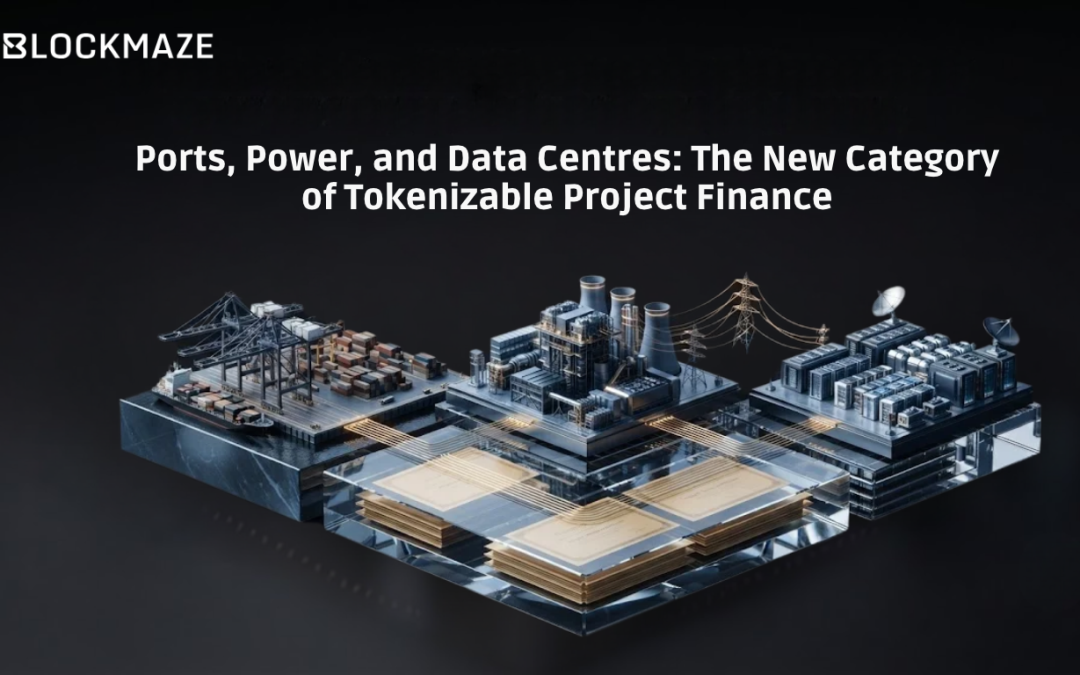
Ports, power plants, and toll roads have been the textbook subjects of infrastructure project finance for decades. Data centres are the newest, fastest-growing entrant into that category, and the scale involved is now large enough to reshape how the entire discipline of project finance operates. Understanding why this new category fits the classic non-recourse structure so well and where the specific frictions in financing it sit clarifies exactly where tokenized capital formation has a genuine role to play.
The Scale of the Data Centre Build-Out
J.P. Morgan estimates hyperscaler capital expenditure will reach $697 billion in 2026 alone, describing AI infrastructure financing as one of the defining capital deployment themes in markets today. McKinsey projects $6.7 trillion in global capital will be deployed for data centre infrastructure through 2030, while Goldman Sachs’ baseline model projects AI-related capital expenditure reaching $765 billion in 2026 and growing to $1.6 trillion annually by 2031 a cumulative $7.6 trillion between 2026 and 2031 across compute, data centres, and power infrastructure combined. JLL’s 2026 Global Data Center Market Outlook translates this into project finance terms directly: the sector’s growth equates to roughly $1.2 trillion in real estate asset value creation and a need for approximately $870 billion in new debt financing, with nearly 100 gigawatts of new data centre capacity expected between 2026 and 2030 alone, doubling global capacity at a 14% compound annual growth rate.
Power: The Larger and More Constrained Half of the Equation
The power infrastructure required to support this build-out is, if anything, the more capital-intensive and more constrained half of the story. US utilities have committed approximately $1.4 trillion to expanding grid capacity specifically for AI data centres, according to an April 2026 analysis of 51 utilities serving 250 million customers a figure that has already risen 27% from the prior year’s projection and effectively doubles the roughly $700 billion invested over the entire previous decade. Globally, an estimated $720 billion in additional grid spending is needed through 2030 to support this demand.
The constraint is physical, not just financial: Morgan Stanley Research forecasts US data centre power demand could reach 74 gigawatts by 2028, against a projected shortfall of roughly 49 gigawatts in available power access a gap driving data centre operators toward on-site natural gas generation, nuclear plant restarts, and direct investment in power generation assets as bridging solutions while grid interconnection queues, which can run five years or longer in constrained markets, remain a binding constraint on how quickly new capacity can actually come online.
Why Ports and Traditional Transportation Still Anchor the Discipline
Ports and broader transportation infrastructure remain foundational to project finance rather than displaced by the newer digital and power categories energy, telecommunications, port facilities, and transportation are explicitly named among the core sectors the technique was originally built to serve, and they continue to represent a substantial share of the $36 trillion in transportation and logistics investment this series’ companion analysis of the global infrastructure gap identifies as needed through 2040. What has changed is the relative growth rate: transportation infrastructure need grows in line with broader economic and demographic trends, while digital infrastructure need has accelerated sharply and specifically because of AI demand, making data centres and power the categories where financing innovation is currently most urgent.
Why This New Category Fits Project Finance Unusually Well
Data centres and the power infrastructure supporting them share a specific structural feature that makes them well suited to the classic project finance model: long-term, creditworthy offtake contracts. A hyperscaler lease a multi-year commitment from a company like Microsoft, Amazon, or Google to occupy and pay for a specific data centre’s capacity functions analogously to a power purchase agreement in a traditional energy project, providing exactly the kind of contracted, predictable cash flow that has always allowed project finance lenders to extend high leverage against an asset that does not yet exist. This is precisely why J.P. Morgan’s own analysis of AI infrastructure financing describes deploying corporate debt, project-level debt, and multi-layered equity structures together the same toolkit traditional project finance has used for power plants and toll roads, applied to a new asset class with a comparably strong underlying cash flow case.
Why This Category Is Also Where Tokenization Fits Most Naturally
The pace and staging of this build-out creates exactly the kind of granular, milestone-driven capital need that tokenized structures are suited to support. Data centre construction can move quickly once land, power, and equipment allocation are secured, while grid interconnection can take years meaning capital committed to a specific project faces genuinely distinct risk phases (construction, power availability, operational ramp) that a single upfront financing tranche represents poorly. Tokenized capital structured around these distinct phases construction-stage capital, power-availability-contingent capital, and stabilised-operation capital could let investors participate at the specific risk-return point in the project lifecycle that matches their own risk appetite, rather than accepting blended exposure across all three phases through a single instrument.
The financing gap itself reinforces the case: JLL’s $870 billion new debt financing estimate and the broader multi-trillion-dollar capital needs documented here exceed what the existing syndicate of infrastructure-focused banks and specialist real estate lenders can underwrite through conventional channels alone, creating exactly the distribution problem this series has identified across every other capital-intensive category one that tokenized structures, extending distribution to a broader verified investor base without displacing the underlying project finance mechanics, are built to address.
Blockmaze and Digital Infrastructure Capital Formation
Blockmaze’s platform is built to support exactly the phased capital structure data centre and power infrastructure projects require. Milestone-based capital release lets investors participate at distinct points in a project’s lifecycle construction, power-availability-contingent, and stabilised operation rather than accepting blended exposure across phases with very different risk profiles and timelines through a single instrument.
Identity-verified allowlists and compliance-enforced transfer restrictions extend distribution of these tokenized tranches to a broader, properly verified investor base beyond the existing syndicate of infrastructure-focused banks and specialist lenders, while Proof of Reserve verification every 15 days gives that broader base the continuous confidence needed to fund a category where power availability and interconnection timelines can shift materially after initial commitment. As data centre and power infrastructure investment accelerates toward the trillions of dollars this analysis has documented, infrastructure built for this specific new category’s staged risk profile is where genuine capital formation progress will be made.
Frequently Asked Questions
1. How much is being spent on data centre infrastructure globally?
McKinsey projects $6.7 trillion in global capital for data centre infrastructure through 2030. J.P. Morgan estimates hyperscaler capex alone will reach $697 billion in 2026, and JLL estimates the sector’s 2026-2030 growth will require approximately $870 billion in new debt financing.
2. How much power infrastructure investment does the AI data centre boom require?
US utilities have committed roughly $1.4 trillion to expanding grid capacity for AI data centres, and an estimated $720 billion in additional global grid spending is needed through 2030 against a projected US power shortfall of about 49 gigawatts by 2028, per Morgan Stanley Research.
3. Why do data centres fit project finance’s traditional model well?
Long-term hyperscaler leases function similarly to power purchase agreements in traditional energy projects, providing the kind of contracted, predictable cash flow that has always allowed project finance lenders to extend high leverage against an asset before it generates revenue.
4. Are ports and traditional infrastructure still relevant to project finance?
Yes, energy, telecommunications, port facilities and transportation remain core project finance sectors, representing a substantial share of the estimated $36 trillion in global transportation and logistics investment needed through 2040.
5. Why does data centre financing suit tokenized, milestone-based capital structures?
Data centre projects move through genuinely distinct risk phases construction, power availability, operational ramp often on different timelines, since construction can proceed quickly while grid interconnection can take five or more years. Tokenized capital structured around these distinct phases lets investors participate at the specific risk-return point that matches their appetite, rather than accepting blended exposure through a single upfront tranche.
Disclaimer: This article is for informational purposes only and does not constitute financial or legal advice. Readers should conduct their own research and consult with qualified professionals before making any investment or business decisions.