Executive TL;DR
| • The RWA crypto market holds $37.89 billion in distributed asset value as of August 2026 — a roughly 9x expansion in 19 months from $4.1 billion in January 2025. The number of wallets holding a tokenised asset has grown 56% in a single month to 1,629,406 holders.
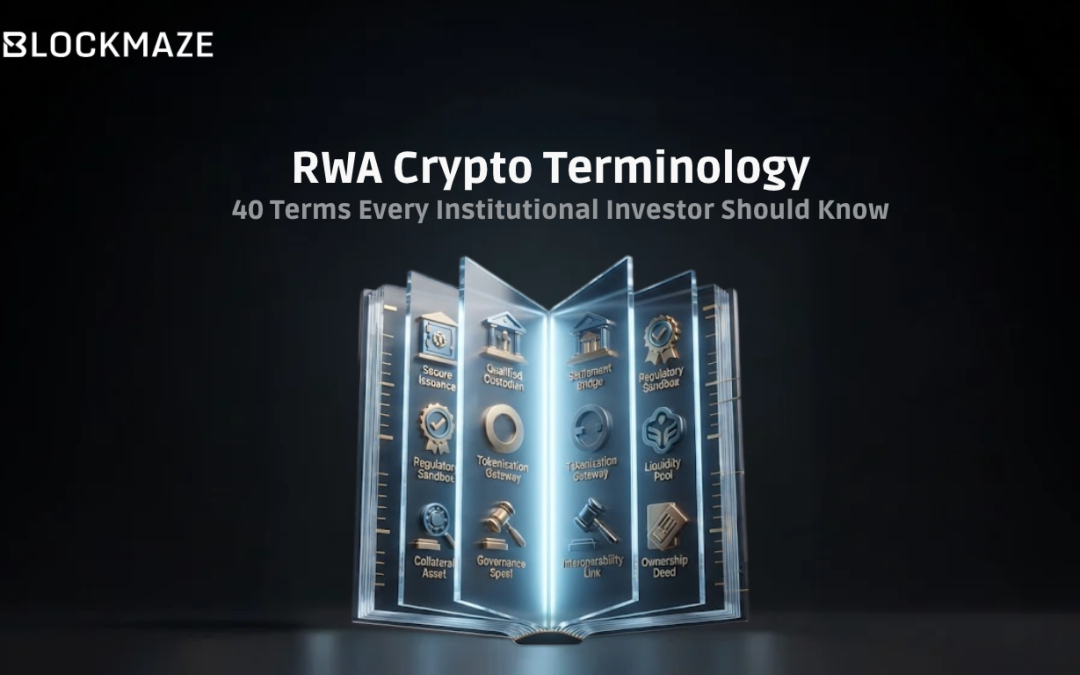
• The vocabulary of tokenised real-world assets draws from three distinct knowledge domains — traditional securities law, blockchain technology, and institutional operations — and participants from each background encounter unfamiliar terms from the other two. This glossary is organised to help institutional investors navigate the full vocabulary without assuming any single background. • Terms are organised into five clusters: Asset and Instrument Terms (what is being tokenised), Infrastructure Terms (how the system works), Compliance and Identity Terms (who can participate), Market and Operations Terms (how assets trade and settle), and Governance and Economics Terms (how networks are run). • Every term in this glossary is linked to a specific, operational concept in the tokenised RWA market as it exists in 2026 — not speculative or theoretical applications. Where a term is specific to the Blockmaze ecosystem, this is noted. • This is a living reference. The RWA market added more new terminology in the 24 months to August 2026 than in the preceding four years combined — a reflection of the pace at which institutional practice is formalising around the technology. |
The RWA crypto market has matured faster in vocabulary than in standardisation which means that the same concept may be described by different terms by different market participants, and the same term may carry different meanings depending on whether the speaker comes from traditional securities law, DeFi protocol development, or institutional custody operations. This glossary attempts to define the 40 most important terms precisely enough to be operationally useful, with enough context to make each term’s relationship to the others clear.
Cluster 1: Asset and Instrument Terms
1. Real-World Asset (RWA)
A financial or physical asset that exists outside blockchain infrastructure — a government bond, a share of equity, a piece of real estate, a commodity, a fund unit, or a private credit instrument — and is represented on a distributed ledger. The representation can be a direct legal claim (a tokenised fund unit backed by the underlying fund’s assets) or a synthetic exposure (a token tracking asset performance through a derivative structure). The distinction matters for investor rights, custody obligations, and accounting treatment.
2. Tokenised Asset
An asset whose ownership record and transfer mechanism are implemented on a blockchain or distributed ledger. More specific than RWA because tokenised asset describes the process (tokenisation has been applied) rather than the category of underlying asset. A tokenised US Treasury is an RWA that has been tokenised; a stablecoin backed by Treasuries is also an RWA product but may or may not involve tokenisation of the underlying bonds.
3. Security Token
A token that represents a security-law regulated interest — ownership in a company, a debt obligation, a right to future cash flows, or an interest in an investment fund. The classification attaches to what the token confers, not what it is called. A token conferring equity-like rights is a security token under US, EU, UK, and most major frameworks regardless of whether it is labelled a ‘utility token.’ See: Howey Test, MiCA.
4. Digital Security
Any financial security in digital rather than physical form. This is a broader term than ‘security token’ — traditional book-entry electronic records at the DTC or Euroclear are digital securities that have nothing to do with blockchain. The term became associated with blockchain in the 2017-2019 period because blockchain-based instrument issuers used it to signal regulatory seriousness relative to utility tokens.
5. Asset-Referenced Virtual Asset (ARVA)
A regulatory category created by VARA (Dubai’s Virtual Assets Regulatory Authority) in its 2025 ARVA rules to cover tokenised real-world assets. An ARVA must be backed by audited reserve assets and its issuer must obtain a VARA licence. The creation of a dedicated ARVA category — rather than forcing tokenised RWAs into existing securities or payments frameworks — is Dubai’s defining regulatory contribution to the institutional RWA market.
6. Tokenised Fund Unit
A token representing a beneficial interest in an investment fund whose underlying assets are managed by a fund manager. The token holder is an investor in the fund; the fund holds the underlying assets (bonds, loans, equities). BlackRock’s BUIDL and Franklin Templeton’s BENJI are the most widely cited examples — both are tokenised money market fund units, not direct claims on specific bonds.
7. Yield-Bearing Asset
A tokenised instrument that distributes income to holders — interest payments from a bond, distributions from a fund, or yield from staked positions. A yield-bearing RWA token is considered more sophisticated than a simple price-tracking token because it requires ongoing income calculation, distribution mechanics, and tax reporting infrastructure. Tokenised Treasuries are the largest yield-bearing RWA category by value.
8. Stablecoin
A cryptocurrency designed to maintain a stable value relative to a reference asset, typically the US dollar. Distinguished from tokenised RWAs in that a stablecoin is a payment instrument whose primary purpose is stability of value, whereas a tokenised asset’s primary purpose is representing ownership or economic rights. The distinction matters for regulation: VARA’s ARVA rules exclude payment tokens; MiCA has separate regimes for e-money tokens (which include most stablecoins) and other crypto-assets.
Cluster 2: Infrastructure Terms
9. Blockchain
A specific distributed ledger data structure in which records are grouped into cryptographically linked blocks, each containing a hash of the preceding block. The cryptographic chaining makes historical records tamper-evident — altering block 1,000 requires redoing the computational work for every subsequent block. All blockchains are distributed ledgers; not all distributed ledgers are blockchains. Bitcoin (2009) and Ethereum (2015) are the most widely referenced blockchains.
10. Distributed Ledger Technology (DLT)
The broader category of which blockchain is a subset: any system in which a record is simultaneously maintained across multiple nodes without a central controlling authority. R3 Corda, IBM Hyperledger Fabric, and DAML-based enterprise ledgers are DLT systems that are not blockchains in the conventional sense. Regulators (BIS, FSB, IMF, IOSCO, MAS, ECB) consistently use DLT rather than blockchain in formal publications because it is more technically precise.
11. Smart Contract
A programme stored on a blockchain that executes automatically when specified conditions are met, without requiring a trusted intermediary to apply the rules. In RWA contexts, smart contracts enforce transfer restrictions, automate income distributions, and implement compliance eligibility checks at the transaction level. ERC-3643 is the most widely adopted smart contract standard for compliance-enforced tokenised securities.
12. ERC-3643
The most widely adopted token standard for institutional tokenised securities on Ethereum-compatible blockchains. ERC-3643 (also called the T-REX standard) enforces transfer restrictions by checking wallet eligibility against an on-chain identity registry before any transfer executes. If the receiving wallet is not on the registry as an eligible investor, the transfer fails automatically. BlackRock’s BUIDL and most major institutional tokenised fund products use ERC-3643 or a similar compliance-enforcement standard.
13. Oracle
A system that delivers external data — prices, exchange rates, interest rates, asset valuations, or real-world events — to a smart contract in a verifiable way. Smart contracts cannot independently access off-chain data; oracles bridge the gap. For RWA applications, oracles are critical for delivering asset valuations (for NAV calculation), interest rate benchmarks (for floating-rate distributions), and event confirmations (for corporate action triggers). Oracle failure or manipulation is one of the primary technical risk categories in tokenised assets.
14. Permissioned vs Permissionless
Two categories of distributed ledger access model. Permissioned systems restrict who can participate — read the ledger, submit transactions, validate blocks — to a defined, known set of entities. Permissionless systems allow any node to participate without approval. Most institutional RWA deployments use permissioned access at the compliance layer (who can hold the asset) on top of permissionless or consortium settlement infrastructure.
Cluster 3: Compliance and Identity Terms
15. Know Your Customer (KYC)
The regulatory process of verifying the identity of individual investors before allowing them to participate in a financial transaction or hold a financial instrument. In tokenised RWA contexts, KYC determines which wallet addresses are added to the transfer restriction allowlist. A wallet whose owner has not completed KYC cannot receive a compliant security token regardless of smart contract mechanics.
16. Know Your Business (KYB)
The corporate equivalent of KYC, applied to institutional counterparties and legal entities rather than individuals. Where KYC verifies a person’s identity, KYB verifies a business’s legal existence, ownership structure, beneficial owners, and regulatory standing. Institutional tokenised asset platforms apply both KYC (to individual signatories) and KYB (to the corporate entity) before onboarding.
17. Anti-Money Laundering / Counter-Terrorism Financing (AML/CTF)
The regulatory obligations requiring financial institutions to identify, report, and prevent money laundering and terrorism financing activity. In tokenised assets, AML/CTF compliance is enforced at onboarding (screening investors against sanctions lists and PEP databases) and at the transaction level (monitoring for suspicious patterns). The FATF Travel Rule — requiring sender and recipient identification for transfers above defined thresholds — applies to tokenised asset transfers just as to other financial transfers.
18. Allowlist / Whitelist
The on-chain registry of wallet addresses approved to hold or receive a specific tokenised instrument. The transfer restriction smart contract checks the receiving wallet against the allowlist before every transfer; wallets not on the list cannot receive the token. The allowlist is operated by the transfer agent or compliance administrator and is updated when investors complete or fail KYC/KYB. This is the technical mechanism that makes compliance-enforced tokenised securities function.
19. Verifiable Credential (VC)
A W3C-standardised digital certificate cryptographically signed by an issuer and held by the subject, representing a verified claim — KYC completion, professional qualification, regulatory accreditation, or any other attestable fact. Unlike a database record, a verifiable credential can be presented and verified by any relying party without contacting the original issuer. eIDAS 2.0 mandates European Digital Identity Wallets that use verifiable credentials for all EU citizens by December 2026.
20. Decentralised Identifier (DID)
A W3C-standardised identifier that is controlled by its subject — a person, organisation, or device — rather than by any centralised registry or issuer. A DID is the cryptographic anchor for a self-sovereign identity: the person controls the private key associated with the DID, and anyone can verify the DID’s associated credentials without a centralised lookup. DIDs and verifiable credentials together form the technical infrastructure for portable, privacy-preserving institutional identity.
Cluster 4: Market and Operations Terms
21. Atomic Settlement
Settlement in which the asset transfer and the payment move simultaneously — either both succeed or both fail, with no interval during which one party holds the asset and the other holds the payment. Traditional securities settlement (T+1 or T+2) creates a settlement interval during which counterparty risk exists. Atomic settlement eliminates this interval. Also called delivery versus payment (DvP) when implemented in a single atomic transaction.
22. T+0 Settlement
Settlement on the same day as the trade — as opposed to T+1 (next day, the current US standard) or T+2 (two days, the previous standard). Tokenised assets can in principle settle atomically in seconds, making T+0 a natural characteristic of blockchain-based settlement. The IMF and BIS have cited T+0 settlement as one of the core advantages of tokenised financial infrastructure relative to traditional systems.
23. Asset Servicing
The operational discipline of maintaining a financial instrument across its full lifecycle — income distribution, corporate action processing, register maintenance, valuation, regulatory and tax reporting, and redemption. Asset servicing begins after issuance and continues for the instrument’s entire life. For a ten-year bond, issuance takes days; asset servicing takes a decade. Tokenisation changes the mechanics of servicing but does not reduce its importance.
24. Corporate Action
An event initiated by a security’s issuer that affects the security or its holders — dividends, stock splits, mergers, rights offerings, partial redemptions, conversions, and tender offers. Corporate actions are one of the hardest servicing functions in tokenised markets because they originate outside the token and must be correctly interpreted and applied to tokenised positions, often in scenarios the smart contract was never designed to handle.
25. Proof of Reserve (PoR)
An independent attestation, typically conducted on a defined cycle, that the assets backing a tokenised instrument are actually present, correctly allocated, and performing as represented. Blockmaze mandates Proof of Reserve attestation every 15 days for instruments issued on its network — the mechanism that gives investors continuous assurance that their tokenised holdings correspond to real underlying assets.
26. Transfer Agent
An SEC-registered (in the US context) or equivalently regulated entity that maintains the official legal register of who owns a security, processes transfers, and handles distributions. In tokenised markets, the transfer agent’s register remains the authoritative legal record of ownership — if the blockchain and the register disagree, the register wins. In March 2026, the NYSE named Securitize the first digital transfer agent eligible to mint blockchain-native securities.
27. Custody / Qualified Custodian
The safekeeping of assets on behalf of a client. A qualified custodian is a regulated entity — typically a bank, trust company, or broker-dealer — authorised to hold client assets under securities regulations. For registered investment advisers and regulated funds, using a qualified custodian is a regulatory requirement. Custodying a tokenised security requires both key security (private key custody) and securities servicing capability (corporate actions, distributions, compliance).
28. Composability
The ability of one financial product or smart contract to interact with another without rebuilding the entire process from the beginning. A tokenised Treasury that can be used as collateral in a lending market, which can settle against tokenised digital money, is composable — the asset functions across multiple financial applications without bespoke integration for each. Composability is one of the primary arguments for tokenised assets over traditional digital assets in institutional contexts.
Cluster 5: Governance and Economics Terms
29. Decentralised Autonomous Organisation (DAO)
A governance structure in which decisions about a protocol or network are made through a defined process — typically token-weighted voting — rather than by a central company or individual. In institutional blockchain networks, DAOs govern protocol parameter changes, validator set composition, treasury allocation, and upgrade schedules. DAOs differ structurally from corporate governance in that enforcement is technical (code executes automatically when votes pass) rather than legal.
30. Validator
A node that participates in the consensus mechanism of a blockchain network, proposing and attesting to new blocks of transactions. Validators are the operational infrastructure of a blockchain network — they determine whether transactions are correctly processed and the network state is accurately maintained. In institutional networks, validators are typically identified, regulated entities operating under governance rules with accountability mechanisms beyond stake slashing.
31. Staking
Locking a quantity of a network’s native token as a commitment to honest participation in consensus. Validators stake tokens that are at risk of being ‘slashed’ (partially or fully confiscated) if they behave dishonestly — the economic mechanism that aligns validator incentives with correct network operation. Staking is the primary utility function of native tokens in proof-of-stake blockchain networks.
32. Network Governance
The process by which decisions about a blockchain protocol’s rules are made. Distinct from corporate governance in that proposals flow upward from participants to token-weighted votes, enforcement is technical rather than legal, and decisions are reversible only through new governance votes rather than board decisions. Four common failure modes: plutocracy (large token holder capture), voter apathy, governance attacks, and parameter gridlock.
33. Protocol Revenue
The portion of value generated by network activity that flows to a defined, transparent structure — a treasury, a validator reward pool, a governance-controlled fund — rather than to a private operating entity. Protocol revenue is what makes a network’s economic model self-sustaining: validators earn revenue from validation, protocol development is funded by treasury, and the network can maintain itself without external subsidies.
34. Multi-Party Computation (MPC)
A cryptographic method of distributing a private key into shares held by multiple parties, so that a transaction can be signed through a distributed computation that never reassembles the complete key in any single location. MPC enables institutional-grade key security with faster transaction signing than hardware security module (HSM) cold storage. Importantly, MPC is a security technology, not a regulatory category — an MPC arrangement can be offered by a qualified custodian or used in unregulated self-custody.
35. Capital Formation
The process of mobilising capital — from investors, institutions, anchor investors, and co-investors — to finance a project, business, or asset. Distinguished from asset tokenisation: tokenisation represents an existing asset digitally; capital formation uses tokenised infrastructure to raise funding for something that does not yet exist as a completed asset. Tokenised infrastructure for capital formation supports milestone-based capital release, multi-party governance, and compliance-enforced access for investors across multiple jurisdictions.
36. Interoperability
The ability of different blockchain networks or systems to exchange information and assets while preserving the properties that make those assets meaningful. Interoperability in tokenised RWA contexts has four layers: message passing (conveying verified information between networks), asset portability (tokens moving while retaining their properties), identity portability (verified credentials remaining valid across networks), and compliance continuity (transfer restrictions surviving the crossing).
37. On-Chain / Off-Chain
Two terms describing where data or processes exist. On-chain refers to data or logic that exists on a blockchain — permanently recorded, cryptographically verifiable, and executable by smart contracts. Off-chain refers to data or processes that exist in traditional systems. Most tokenised asset structures are hybrid: on-chain ownership records and transfer mechanics with off-chain legal registers, tax processing, and regulatory filings.
38. Liquidity
The ability to convert an asset into cash (or another asset) at a fair price in a reasonable timeframe without materially moving the market. A common misconception about tokenised assets is that tokenisation automatically creates liquidity. It does not — a tokenised asset still requires buyers, sellers, market makers, price discovery mechanisms, appropriate regulation, and reliable settlement to be liquid. Tokenisation changes the infrastructure of liquidity; it does not create liquidity by itself.
39. Atomic Swap
A technology that enables two parties to exchange different tokenised assets simultaneously and atomically — either both transfers complete or neither does — without requiring a trusted intermediary to hold one side of the exchange. Atomic swaps are a key enabling technology for cross-chain settlement and peer-to-peer asset exchange in tokenised markets.
40. Community Capital Formation
A capital formation structure in which an anchor investor provides the initial, credibility-establishing commitment to a project, opening participation to a broader community of institutional and smaller co-investors who join on the strength of the anchor’s due diligence. Distinct from crowdfunding (which is retail-oriented and typically unregulated) and from traditional syndication (which is bilateral between large institutions). Tokenised infrastructure enables community capital formation by making compliance-enforced co-investment accessible to a broader participant base.
Frequently Asked Questions
1. How large is the RWA crypto market?
The tokenised RWA market holds $37.89 billion in distributed asset value as of August 2026, representing approximately 9x growth from $4.1 billion in January 2025. The number of wallets holding a tokenised asset has grown to 1,629,406, up 56% in a single month.
2. What is the difference between a security token and a digital security?
A security token is a regulatory classification — a token that confers a securities-law regulated interest, determined by what it does rather than what it is called. A digital security is a broader term covering any security in digital rather than physical form, including traditional book-entry electronic records that predate blockchain by decades.
3. What is ERC-3643 and why does it matter for institutional RWAs?
ERC-3643 (the T-REX standard) is the most widely adopted smart contract standard for compliance-enforced tokenised securities. It enforces transfer restrictions by checking wallet eligibility against an on-chain identity registry before any transfer executes — the technical mechanism that makes compliant tokenised security transfers possible. BlackRock’s BUIDL and most major institutional tokenised fund products use this or an equivalent standard.
4. What is the difference between staking and yield-bearing assets?
Staking involves locking a blockchain network’s native token to participate in consensus, earning rewards for honest validation. Yield-bearing assets are tokenised financial instruments (bonds, funds, loans) that distribute income from an underlying real-world asset — interest payments or fund distributions. These are economically distinct: staking rewards come from network economics, yield-bearing asset returns come from real-world financial cashflows.
5. What does community capital formation mean in the context of tokenised assets?
A structure where an anchor investor commits capital to a project first, providing a credibility signal that opens participation to a broader community of institutional and smaller co-investors. Tokenised infrastructure makes this possible by enforcing compliance-controlled access across multiple investor tiers while maintaining transparent, auditable records of who invested what and when.
Disclaimer: This article is for informational purposes only and does not constitute financial or legal advice. Readers should conduct their own research and consult with qualified professionals before making any investment or business decisions.