Executive TL;DR
|
Institutional investors and issuers evaluating Blockmaze as an infrastructure partner frequently want to understand not just the platform’s compliance architecture but also its network architecture: who maintains the infrastructure, how it is secured, and how governance and network participants relate to each other. This article explains the four key ecosystem roles validators, delegators, governance council members, and developer/partner participants and how they interact to produce a functional, secure, and governed institutional tokenisation platform.
Validators: The Network’s Infrastructure Layer
What Validators Do
Validators are the participants who maintain the Blockmaze network’s operational infrastructure. They run the node software that validates transactions, confirms blocks, and maintains the shared ledger that records all tokenised asset transactions, governance votes, and compliance events on the platform. Without validators, the network has no operational backbone no transactions can be confirmed and no records can be written.
On a proof-of-stake network like Blockmaze, validators are required to hold and lock (stake) a defined minimum amount of the network’s native token as collateral. This economic commitment creates a financial incentive for validators to behave honestly: validators who behave maliciously or whose infrastructure performs poorly are subject to slashing, a penalty mechanism that destroys a portion of their staked collateral. The combination of required stake and slashing risk makes it economically rational for validators to maintain high uptime, honest transaction validation, and compliance with the governance-set validator standards.
Validator Standards
Validator standards the technical, operational, and ethical requirements that validators must meet to participate in the network are set through the DAO governance process rather than by Blockmaze unilaterally. This means that the community of validators and governance participants collectively determine what the network’s infrastructure requirements are, and that changes to those requirements go through the same proposal and vote process as other governance decisions.
Institutional investors in Blockmaze-issued instruments depend on validators indirectly but materially: validator performance determines network availability, transaction confirmation times, and the consistency of the record on which their ownership is based. The DAO-governed validator standards are the mechanism through which that quality is maintained at an institutional level.
Delegators: Economic Support for Network Security
What Delegators Do
Delegators are token holders who do not operate validator infrastructure themselves but want to participate in network security and earn staking rewards. They delegate their token stake to a validator of their choice, effectively lending their economic weight to that validator’s security collateral. In exchange, they receive a proportional share of the rewards the validator earns minus the validator’s commission.
Delegation is how the network’s security scales beyond the relatively small number of qualified validators. A validator running high-quality infrastructure but holding only a limited amount of native tokens gains additional economic security through delegators. More delegated stake means a higher slashing penalty for misbehaviour and more rewards distributed creating a competitive dynamic in which validators who maintain high performance and institutional-grade infrastructure attract more delegation than those who do not.
Why Delegation Matters for Institutional Participants
For institutional participants holding the Blockmaze native token, delegation provides a mechanism for putting that token holding to productive use earning yield while contributing to the security of the network that underlies their tokenised asset positions. The delegation relationship is not a custodial transfer: delegators retain ownership of their staked tokens; they are not lending them in the sense of a credit transaction. The stake is locked for a defined period and then fully recoverable.
Governance Council Members: The Decision-Making Layer
Governance council members are the participants who review and vote on DAO proposals the issuance approvals, compliance parameter changes, and emergency actions described in the DAO governance article elsewhere in this series. Governance council membership is distinct from validator or delegator status: a governance council member participates in the platform’s decision-making processes, not its infrastructure operation.
The council uses quadratic voting for all DAO decisions, meaning that governance outcomes reflect a balanced distribution of perspectives rather than pure stake concentration. Council members are qualified participants institutional entities that have met the platform’s eligibility requirements and their votes are recorded onchain for the full transparency that institutional-grade governance requires.
The governance council is the institutional integrity layer of the Blockmaze ecosystem. When an issuer submits a proposal, it is the council that reviews it, asks questions, and determines whether it should be approved. When an emergency action is proposed, it is the council vote that determines whether it proceeds. The council’s onchain voting record is the permanent, independently verifiable evidence of the governance quality that institutional investors rely on when they choose to hold positions in Blockmaze-issued instruments.
Developer and Partner Participants: The Ecosystem’s Builder Layer
The fourth participant category encompasses developers, technology partners, and institutional participants who engage with the Blockmaze ecosystem through the RFP Portal and Developer Portal. These participants may build on the platform’s infrastructure, submit grant applications for ecosystem development projects, integrate with the platform’s APIs, or participate in the technical standards processes that shape how the platform evolves.
For institutional issuers, the developer and partner ecosystem is relevant in two ways. First, it determines the availability and quality of tooling wallets, reporting interfaces, secondary market integrations, oracle services that institutional participants interact with beyond the core issuance and governance functions. Second, it signals the platform’s ecosystem health: a growing developer and partner ecosystem reflects confidence in the platform’s institutional trajectory and provides institutional participants with a more capable and connected set of tools than a platform with minimal external development activity.
How the Four Roles Interconnect
| Role | Primary Function | Earns From | Depends On |
|---|---|---|---|
| Validator | Validate transactions; maintain network | Block rewards + transaction fees | Delegation for economic security; DAO for standards |
| Delegator | Stake tokens to validators | Share of validator rewards | Validator performance and reputation |
| Governance Council | Review and vote on DAO proposals | Governance participation rewards (where applicable) | Validator infrastructure for onchain vote recording |
| Developer/Partner | Build tooling and integrations | Grant programmes; commercial agreements | Platform infrastructure; governance for standards approval |
The Ecosystem and Blockmaze’s Guinness World Record
On 13 July 2026, the Blockmaze Foundation received the Guinness World Records title for the most financial regulatory licences at a blockchain ecosystem launch more than 40 regulator-issued authorisations and registrations across eight jurisdictions. This record reflects not just the platform’s compliance infrastructure but the ecosystem architecture that underlies it: validators providing the network security, delegators supporting the economic foundations, governance council members providing the institutional accountability, and developers building the tooling that institutional participants use.
The 40+ licences collectively cover the full scope of the Blockmaze ecosystem from the network-level infrastructure to the issuance and distribution functions, across eight regulatory jurisdictions including Bahrain, Cyprus, the UAE, Canada, Australia, South Africa, Greece, and Mauritius. Institutional participants in any of these jurisdictions interact with an ecosystem that is licensed and regulated in their home market, not merely accessible through a cross-border workaround.
Frequently Asked Questions
1. What is the minimum stake required to become a Blockmaze validator?
Validator requirements including minimum stake are set through the DAO governance process and are documented on the Blockmaze validator portal (blockmaze.org/validator). The requirements reflect institutional-grade infrastructure standards rather than consumer-grade participation thresholds.
2. Can an institution be a delegator and a governance council member simultaneously?
Yes. Institutional participants can hold multiple roles within the Blockmaze ecosystem simultaneously. An institution might stake tokens as a delegator, participate in governance council votes, and also operate as an issuer each role operates under its own rules and requirements.
3. How is the governance council composed who decides who is on it?
Governance council composition is determined through the DAO governance process itself. Becoming a governance council member requires meeting eligibility requirements that are set and maintained by the DAO, ensuring that the council’s composition reflects the standards the ecosystem has collectively decided are appropriate.
4. What is the RFP Portal and who can use it?
The RFP Portal (blockmaze.org/rfp) allows developers, validators, and institutional partners to submit proposals, grant applications, and infrastructure requests for review under Blockmaze’s structured ecosystem programmes. It is the primary channel through which the developer and partner participant category engages with the platform.
5. Does the Blockmaze ecosystem include a swap function?
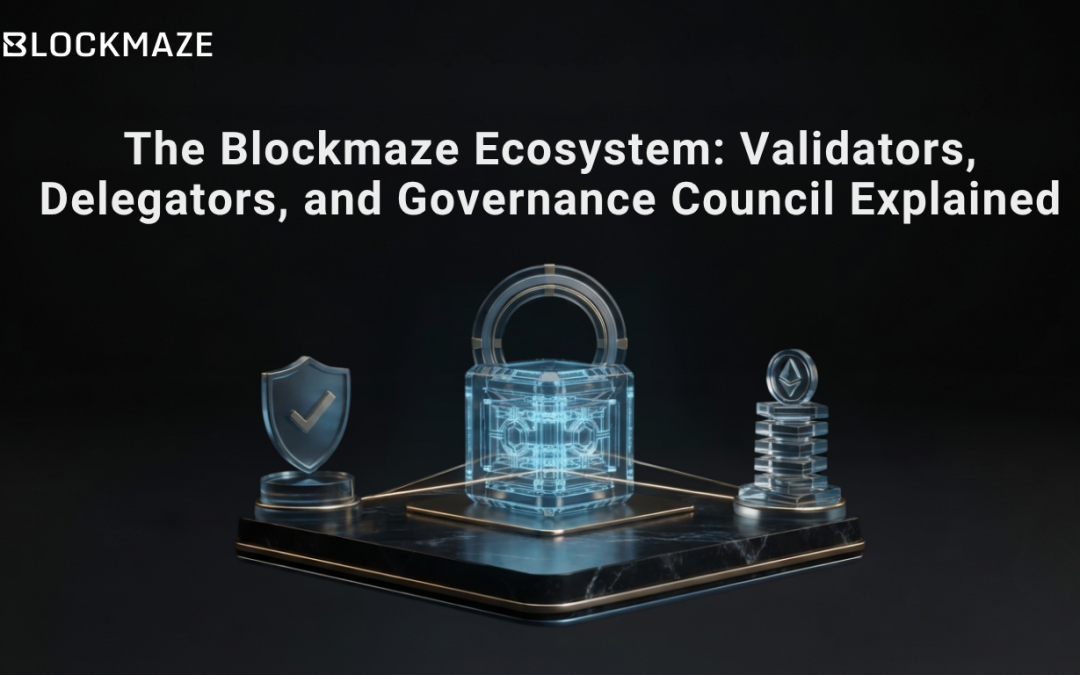
Premium minimalist 3D blockchain ecosystem blog cover on a matte black background. A luxurious black marble platform with subtle gold trim centered in the composition. At the center stands a premium transparent crystal-glass blockchain hub with a soft steel-blue internal glow, representing the Blockmaze ecosystem. Three distinct crystal-glass structures surround it in a balanced triangular arrangement: a secure shield-shaped pillar symbolizing Validators, elegant stacked crystal tokens representing Delegators, and a refined circular council ring with subtle gold accents representing the Governance Council. Thin glowing gold connection lines link all three components to the central hub, illustrating collaboration within the ecosystem. Soft cinematic studio lighting, realistic glass and metallic materials, elegant reflections, shallow depth of field, restrained steel-blue ambient lighting with warm golden highlights, Octane Render, ultra-realistic 3D, premium fintech editorial style, luxurious black-and-gold aesthetic, clean centered composition with generous negative space. Large bold white headline: “The Blockmaze Ecosystem: Validators, Delegators, and Governance Council Explained”. No subtitle, no logos, no floating icons, no network dots, no charts, no extra UI elements, 4K, premium corporate designYes. The Blockmaze ecosystem includes a native swap function (blockmaze.org/swap) for ecosystem token exchange. The swap operates within the platform’s compliance framework rather than as an open, unrestricted market.
Disclaimer: This article is for informational purposes only and does not constitute financial or legal advice. Readers should conduct their own research and consult with qualified professionals before making any investment or business decisions.