
Executive TL;DR
|
Private credit’s rise over the past fifteen years offers a direct precedent for what is likely to happen in infrastructure finance next, and the mechanism is the same in both cases: regulatory capital requirements made banks structurally worse at holding certain categories of risk on their own balance sheets, and non-bank capital moved in to fill exactly that gap. Understanding this pattern clarifies why tokenized infrastructure capital and syndicated bank debt are better understood as complementary layers of the same capital stack than as competitors for the same financing role.
Why Basel III Pushed Banks Out of Certain Lending Categories
The regulatory story is well established: Basel III and related post-2008 capital rules made leveraged lending and middle-market corporate credit expensive for banks to hold, because these categories of risk carry higher capital charges relative to the returns banks can earn on them once the full cost of regulatory capital is accounted for. Basel III’s ongoing Endgame reforms often called Basel 3.1 in some jurisdictions extend this further, recalibrating how banks calculate risk-weighted assets and imposing an output floor that prevents internally modelled risk weights from falling below 72.5% of standardised measurements, a change that further constrains how cheaply banks can hold higher-risk lending categories on their balance sheets.
Wolters Kluwer’s analysis of the resulting market shift is direct: Basel III capital requirements make middle-market lending structurally uneconomic on traditional bank balance sheets, forcing banks to redefine their role as infrastructure and compliance providers rather than principal lenders for that category of risk.
How Private Credit Filled Exactly That Gap
Private credit’s growth traces directly to this regulatory shift. The Financial Stability Board estimated global private credit assets at $1.5-2 trillion by the end of 2024, according to Investing.com’s 2026 analysis, growing nearly tenfold from pre-financial-crisis levels. Industry projections place the figure above $4 trillion by 2028, and non-bank lenders now originate more than 60% of sub-$100 million corporate loans, according to Wolters Kluwer’s research a level of market share migration that reflects a genuine structural realignment rather than a cyclical anomaly that will reverse when rates or credit conditions shift.
Large-cap financing has responded to the same dynamic by dual-tracking between traditional syndicated loan markets and private credit alternatives, according to industry analysis of the private credit market’s evolution, with direct lenders now capable of underwriting multi-billion-euro transactions independently, thanks to scale and permanent capital partners that did not exist in this market a decade ago.
Why Infrastructure Faces the Same Constraint
Infrastructure project finance debt shares the structural characteristics that make bank balance sheets a poor fit under Basel III: long tenors (often 15-25 years), non-recourse structures that carry inherently higher risk weightings than corporate lending to an operating company with diversified revenue, and, particularly for newer categories like data centre and power infrastructure, a risk profile still being calibrated by rating agencies and regulators. These are precisely the characteristics long duration, elevated risk weighting, less standardised underwriting that Basel III’s capital framework penalises most heavily, meaning banks face the same balance sheet economics constraint in infrastructure lending that pushed them out of middle-market corporate credit over the past decade.
This does not mean banks are exiting infrastructure lending entirely senior secured infrastructure debt, backed by strong security packages and syndicated across a group of relationship lenders, remains a category where banks retain real underwriting expertise and continue to participate. What Basel III constrains most is banks’ capacity to hold the full infrastructure capital stack, particularly the subordinate and mezzanine layers that carry higher risk weightings without the same security package protecting senior lenders.
Where Tokenized Capital Fits: Alongside, Not Instead Of
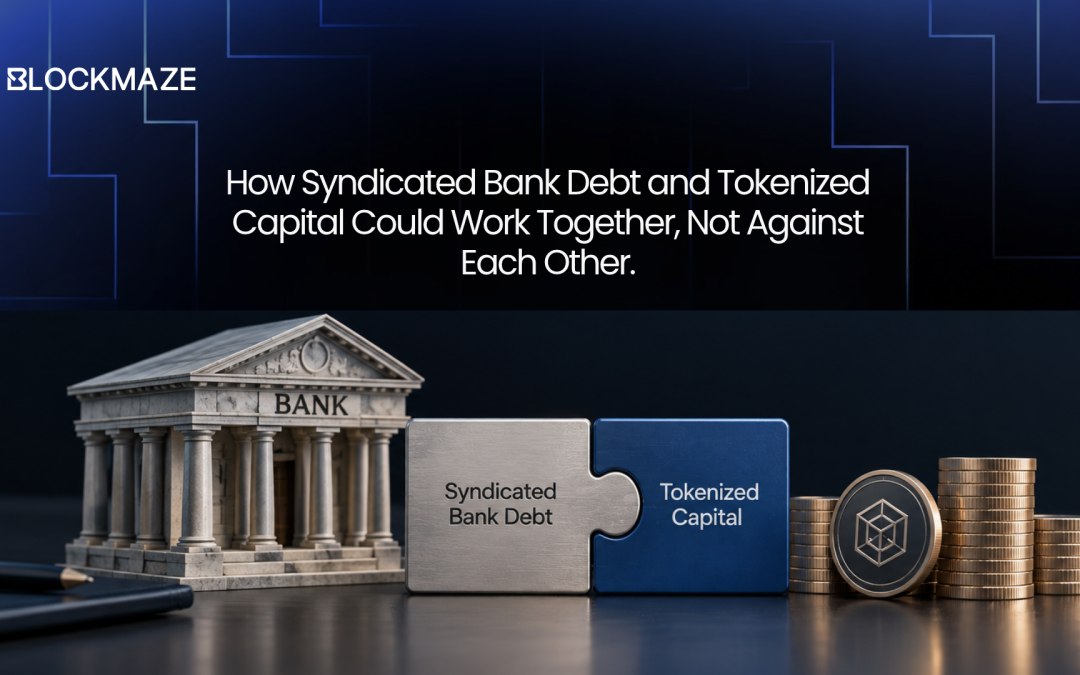
The precedent set by private credit’s growth suggests the productive path for infrastructure is not tokenized capital displacing syndicated bank debt, but tokenized capital occupying exactly the layers of the infrastructure capital stack that Basel III makes structurally uneconomic for banks to hold at scale subordinate debt, mezzanine tranches, and construction-risk-heavy early-stage capital that requires a higher return to compensate for risk banks are specifically disincentivised from carrying on balance sheet. Banks, meanwhile, continue anchoring the senior secured tranche, where their underwriting relationships, security package expertise, and syndication networks remain genuinely valuable and are not meaningfully threatened by tokenized alternatives further down the capital stack.
This is a direct parallel to how private credit and syndicated bank lending now coexist in corporate finance rather than compete head-on: large-cap borrowers dual-track between both markets depending on which structure fits a specific tranche’s risk profile, and banks have adapted by becoming, in Wolters Kluwer’s framing, infrastructure and compliance providers for capital structures they no longer hold entirely on their own balance sheet. Tokenized infrastructure capital extending that same logic broader distribution for the tranches banks are least suited to hold, continued bank participation in the tranches they remain well suited to underwrite is a complementary evolution of the capital stack rather than a competitive threat to it.
What This Means for How Infrastructure Deals Get Structured
In practice, this points toward infrastructure financings that blend a conventional, bank-syndicated senior tranche retaining the security package, covenant structure, and relationship-based underwriting banks do well with a tokenized mezzanine or subordinate tranche distributed to a broader, properly verified base of institutional and accredited investors who can accept the higher risk-weighted exposure banks are now structurally discouraged from holding themselves. Neither tranche needs to displace the other; each is suited to a different position in the risk-return stack, financed by the type of capital genuinely best positioned to hold that specific risk.
Blockmaze and Complementary Infrastructure Capital Stacks
Blockmaze’s platform is built to occupy exactly the layer of the infrastructure capital stack this analysis identifies as structurally underserved by bank balance sheets under Basel III subordinate and mezzanine tranches carrying the higher risk weightings that make them expensive for banks to hold, while leaving senior secured bank debt untouched and complementary rather than displaced.
Compliance-enforced transfer restrictions and identity-verified allowlists extend distribution of these tokenized tranches to a broader, properly verified base of institutional and accredited investors capable of accepting that risk profile, while Proof of Reserve verification every 15 days provides the continuous confidence a mezzanine or subordinate position without a bank’s direct security package particularly requires. As infrastructure financing increasingly dual-tracks between conventional bank debt and alternative capital sources, following the same pattern private credit has already established in corporate lending, infrastructure built for this complementary role is where tokenized capital adds genuine, lasting value.
Frequently Asked Questions
1. Why did Basel III push banks out of certain lending categories?
Basel III capital requirements impose higher capital charges on leveraged and middle-market lending relative to the returns banks can earn once regulatory capital costs are accounted for, making this category of risk structurally uneconomic to hold on bank balance sheets at scale.
2. How large has private credit grown as a result?
Global private credit assets reached an estimated $1.5-2 trillion by the end of 2024, according to the Financial Stability Board, and are projected to surpass $4 trillion by 2028, with non-bank lenders now originating more than 60% of sub-$100 million corporate loans.
3. Does infrastructure debt face the same Basel III constraints as corporate lending?
Yes. Long-tenor, non-recourse infrastructure debt carries the same combination of long duration and elevated risk weighting that Basel III’s capital framework penalises most heavily, creating a similar balance sheet economics constraint for banks as the one that pushed them out of middle-market corporate lending.
4. Does tokenized infrastructure capital compete with syndicated bank debt?
The more productive framing is complementary rather than competitive: tokenized capital is best suited to the subordinate and mezzanine tranches Basel III makes structurally uneconomic for banks to hold, while banks continue anchoring the senior secured tranche where their underwriting and syndication expertise remains genuinely valuable.
5. What does the Basel III Endgame ‘output floor’ do?
It prevents banks’ internally modelled risk weights from falling below 72.5% of standardised measurements, further constraining how cheaply banks can hold higher-risk lending categories, including long-tenor infrastructure debt, on their balance sheets.
Disclaimer: This article is for informational purposes only and does not constitute financial or legal advice. Readers should conduct their own research and consult with qualified professionals before making any investment or business decisions.