
Executive TL;DR• Custody is the first question institutional investors ask about tokenized securities and the last one that gets a satisfying answer. The choice between qualified custodian, self-custody, and MPC-based arrangements determines regulatory standing, insurance coverage, operational control, and — critically — whether a regulated institution can hold the instrument at all. • Three security architectures dominate institutional digital asset custody: HSM-based cold storage, multi-party computation (MPC) with configurable M-of-N thresholds, and multi-signature arrangements requiring independent co-signers. Leading custodians increasingly combine all three in layered stacks rather than choosing one. • The custody provider landscape has institutionalised rapidly. BitGo completed its IPO in January 2026, raising $212.8 million at a valuation exceeding $2 billion — the first public listing by a dedicated digital asset custodian — and holds approximately $104 billion in assets under custody with $250 million in insurance coverage. • Independent counterparty risk assessment now exists for custodians. Agio Ratings publishes probability-of-default assessments: as of Q1 2026, Fidelity Digital Assets led at 0.39%, followed by Coinbase Prime at 0.49% and Komainu at 0.66% — giving institutions a standardised framework for evaluating custodian counterparty risk. • For tokenized securities specifically, the custody decision carries an additional dimension beyond digital asset custody generally: the custodian must be able to support corporate actions, income distribution, and compliance-restricted transfers — servicing functions that generic crypto custody was not originally designed to handle. |
Every institutional conversation about tokenized securities eventually arrives at the same question: who holds it, and what happens if they fail. This is not a technology question. It is the foundational question of securities ownership, and it has been answered in traditional markets through centuries of custodian law, segregation requirements, and insolvency protections. Tokenized securities require the same question to be answered again, against infrastructure where the practical mechanics of ownership are cryptographic rather than contractual.
The Three Security Architectures
HSM-Based Cold Storage
Hardware security modules store private keys in tamper-resistant physical devices, typically kept offline in geographically distributed secure facilities. This is the deepest-reserve custody model — highest security, slowest access. For institutional holdings that do not need frequent transaction signing, HSM cold storage remains the baseline standard, and it is what most institutions picture when they imagine institutional custody.
Multi-Party Computation (MPC)
MPC splits a private key into shares distributed across multiple parties, with transactions signed through a distributed computation that never reassembles the complete key in any single location. Institutional MPC implementations use configurable M-of-N threshold arrangements — 2-of-3, 3-of-5 — matched to the client’s internal approval policies. The operational advantage over cold storage is speed: MPC supports transaction signing within institutional approval workflows without requiring physical access to offline devices.
Multi-Signature
Multi-signature custody requires multiple independent private keys, each held by a different authorised party or system, to co-sign a transaction before it executes. BitGo pioneered institutional multi-signature custody in 2013, and multisig remains widely used where MPC is less natively supported. The distinguishing characteristic relative to MPC is onchain visibility: the multi-signature threshold requirement is visible on the blockchain, whereas MPC produces a single signature that reveals nothing about the underlying distributed arrangement.
In practice, leading institutional custodians do not choose one architecture. They combine them in layered stacks: HSM cold storage for deep reserves, MPC for operational transaction signing, and multi-signature for governance approvals requiring multiple organisational stakeholders.
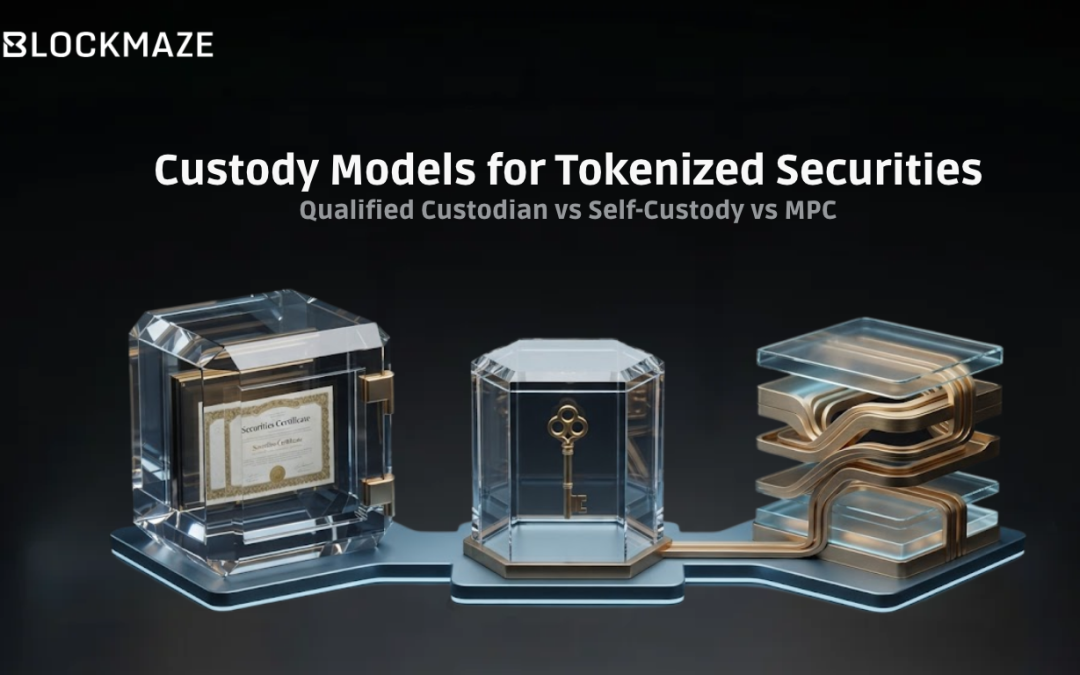
The Three Custody Models
| Model | Who Controls Keys | Regulatory Standing | Best Suited To |
|---|---|---|---|
| Qualified custodian | Regulated third-party custodian | Strongest — satisfies SEC/OCC custody requirements for RIAs and regulated funds | Regulated institutions with fiduciary obligations |
| Self-custody | The institution itself | Weakest — generally does not satisfy qualified custodian requirements | Crypto-native firms; treasury operations without RIA obligations |
| MPC (as a model) | Distributed between institution and provider | Varies — depends on the provider’s regulatory status, not the technology | Institutions needing operational control with institutional-grade security |
An important clarification that the industry frequently obscures: MPC is a security technology, not a regulatory category. An MPC arrangement can be offered by a qualified custodian (satisfying regulatory custody requirements) or used in a self-custody configuration (not satisfying them). The regulatory question is who holds legal custody, not which cryptographic method secures the keys.
The Institutionalisation of the Custody Market
The digital asset custody market has undergone significant institutional maturation. BitGo’s January 2026 IPO — raising $212.8 million at a valuation exceeding $2 billion — marked the first public listing by a dedicated digital asset custodian, bringing custody operations under public market scrutiny with the associated transparency, governance, and financial reporting requirements. Anchorage Digital has been widely expected to pursue a similar path.
Federal chartering has been the other major structural development. OCC national trust charters give custodians a single uniform supervisory regime in place of a state-by-state licensing patchwork, reducing compliance overhead and simplifying the qualified custodian determination for RIA clients evaluating whether a given custodian satisfies their regulatory obligations.
Perhaps most usefully for institutional evaluation, independent counterparty risk assessment now exists. Agio Ratings publishes probability-of-default assessments for major crypto custodians — Fidelity Digital Assets at 0.39%, Coinbase Prime at 0.49%, Komainu at 0.66% as of Q1 2026 — incorporating financial strength, regulatory status, security track record, and operational resilience into a standardised comparison framework.
The Additional Requirement for Tokenized Securities
Custody for tokenized securities requires capabilities beyond generic digital asset custody. A custodian holding Bitcoin needs to secure keys and execute transfers. A custodian holding a tokenized bond needs to additionally support income distribution to the correct holders, process corporate actions correctly, and respect the compliance-enforced transfer restrictions that make the instrument a regulated security in the first place.
This is a meaningfully different capability set, and it is where custodians built for cryptocurrency and custodians built for securities diverge. An institution evaluating custody for tokenized securities should specifically test whether the custodian can process a coupon payment, handle a corporate action, and enforce a whitelist transfer restriction — not merely whether it can hold and transfer a token.
Frequently Asked Questions
1. What is a qualified custodian and why does it matter?
A qualified custodian is a regulated entity — typically a bank, trust company, or broker-dealer — authorised to hold client assets under securities regulations. For registered investment advisers and regulated funds, using a qualified custodian is a regulatory requirement, making the custodian’s qualified status a gating factor for institutional participation.
2. Is MPC a regulatory category or a technology?
A technology. MPC is a cryptographic method for distributing key control; it says nothing about who holds legal custody. An MPC arrangement can be offered by a qualified custodian or used in self-custody. The regulatory question is who holds legal custody, not which cryptographic method secures the keys.
3. How do institutions assess custodian counterparty risk?
Agio Ratings publishes probability-of-default assessments for major custodians (Fidelity Digital Assets 0.39%, Coinbase Prime 0.49%, Komainu 0.66% as of Q1 2026), incorporating financial strength, regulatory status, security track record, and operational resilience. Institutions also evaluate insurance coverage, assets under custody, and regulatory charter type.
4. What does BitGo’s IPO signal for the custody market?
BitGo’s January 2026 listing — $212.8 million raised at a valuation above $2 billion — was the first public listing by a dedicated digital asset custodian. Public market listing imposes transparency, governance, and financial reporting requirements that further align digital asset custody with traditional financial infrastructure standards.
5. Why does tokenized securities custody differ from cryptocurrency custody?
Tokenized securities require the custodian to support income distribution, corporate action processing, and compliance-enforced transfer restrictions — servicing capabilities that generic cryptocurrency custody was not designed for. Institutions should test these specific functions, not just key security and transfer capability.
Blockmaze, Custody, and the Compliance Layer
Blockmaze’s network does not replace institutional custody arrangements — it works alongside them. The Proof of Reserve attestation that Blockmaze mandates every fifteen days provides the independent verification layer that connects the on-chain token record to the assets held by custodians: external confirmation that the instruments outstanding on the network correspond to real, verifiable holdings in regulated custody. The compliance-enforced transfer architecture — identity-verified allowlists and restricted transfer mechanics — integrates with custodian eligibility frameworks, ensuring that the transfer restriction the custodian would enforce at the securities level is also enforced at the token level. And the asset servicing infrastructure on the Blockmaze network — income distribution, corporate action processing, register maintenance — addresses the specific capability gap this article identifies: the difference between a custodian that can hold a token and one that can service a tokenised security across its full lifecycle.
Disclaimer: This article is for informational purposes only and does not constitute financial or legal advice. Readers should conduct their own research and consult with qualified professionals before making any investment or business decisions.