
Executive TL;DR• This comparison does not have a winner. Tokenized stocks and traditional brokerage serve different needs, have different structural properties, and suit different investor profiles and strategies. The purpose of this comparison is to map the genuine differences including the areas where traditional brokerage remains clearly superior rather than to make a promotional case for tokenization. • Tokenized stocks’ genuine advantages: 24/7 trading (Binance bStocks records $2B in weekend volume), on-chain composability (a tokenized stock can serve as DeFi collateral), borderless access for eligible investors outside the brokerage coverage area, and atomic settlement when both legs of a transaction are on-chain. • Traditional brokerage’s genuine advantages: SIPC protection ($500,000 per customer), regulatory certainty under established investor protection frameworks, voting rights (most tokenized stocks do not convey voting rights), broader asset access (10,000+ stocks vs 46+ for bStocks at launch), and direct stock ownership recognised by the issuing company. • The structural difference that matters most: traditional brokerage registers the investor in the issuing company’s records as a beneficial owner. Most tokenized stock structures do not Cede & Co. or the tokenized stock issuer remains the registered holder, and the token holder has a contractual claim on the economics rather than legal ownership in the traditional sense. • Practical conclusion: investors who need after-hours access, DeFi composability, or access to equity markets through crypto-native infrastructure have genuine reasons to use tokenized stocks. Investors who need SIPC protection, voting rights, access to the full range of listed equities, or the investor protections of established broker-dealer regulation have genuine reasons to use traditional brokerage. |
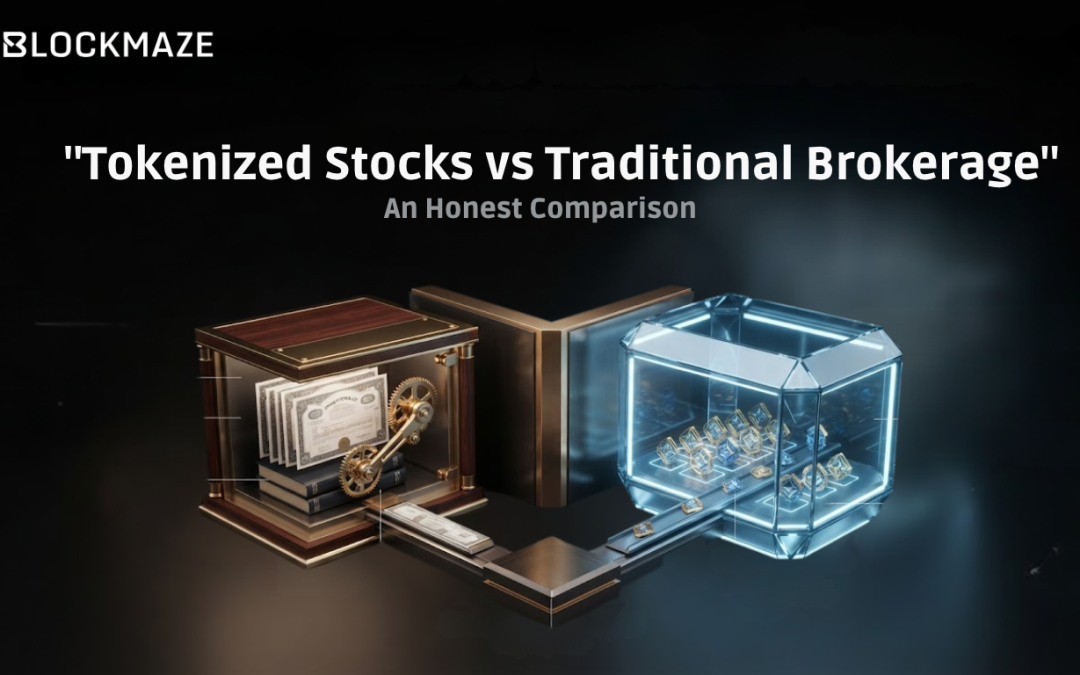
Honest comparisons in financial products are rare. Marketing comparisons exist to advocate; genuine comparisons examine trade-offs that include disadvantages. The following comparison applies that standard to tokenized stocks versus traditional brokerage, identifying where each structure is genuinely superior rather than building a case for either.
The Structural Comparison
| Dimension | Tokenized Stocks | Traditional Brokerage | Advantage |
|---|---|---|---|
| Trading hours | 24/7 — $2B Binance bStocks weekend volume demonstrates real demand | 9:30am-4:00pm US ET (equities), with limited pre/post market | Tokenized stocks |
| Asset access | 46+ (bStocks at launch); $955M on-chain equities (Ondo); expanding | 10,000+ equities, bonds, funds, options, futures at major brokers | Traditional brokerage by volume; tokenized expanding |
| Settlement speed | Seconds (token transfer); atomic if both legs on-chain; T+1 if fiat payment leg | T+1 (US equities since May 2024); T+2 for many international markets | Tokenized for same-day; traditional for full market access |
| Investor protection | Varies by issuer jurisdiction; no equivalent to SIPC in most structures | SIPC protection: $500,000 per customer ($250,000 cash) in US | Traditional brokerage clearly |
| Voting rights | Most tokenized stocks do not convey voting rights to token holders | Registered beneficial owners receive voting rights via proxy | Traditional brokerage clearly |
| Regulatory certainty | Evolving; jurisdiction-dependent; MiCA, VARA, SEC guidance still developing | Established framework in all major jurisdictions; decades of precedent | Traditional brokerage clearly |
| On-chain composability | Token usable as DeFi collateral, in structured products, across protocols | Shares sit in custody; no native DeFi integration | Tokenized stocks for DeFi users |
| Geographic access | Available to eligible investors globally (subject to exclusions) | Varies by broker licence; US-only brokers exclude international investors | Tokenized stocks for some markets |
| Dividend treatment | Distributed as stablecoins by most issuers; tax treatment unclear in many jurisdictions | Fiat dividends to registered account; established tax treatment | Traditional brokerage for clarity |
| Short selling / margin | Available on some platforms; complex mechanics vs traditional margin | Established margin accounts; securities lending infrastructure | Traditional brokerage for now |
Where Traditional Brokerage Is Unambiguously Better
SIPC Protection
In the US, brokerage accounts are protected by SIPC up to $500,000 per customer (including $250,000 in cash) if a broker-dealer fails. This protection applies to the securities registered in the account, which is a meaningful backstop for retail investors in particular. No equivalent regulatory protection exists for tokenized stock holders at any platform currently operating the protection depends entirely on the legal structure of the issuer and the custodial arrangements, which vary significantly.
Voting Rights
A shareholder in a company listed on a traditional exchange has voting rights that a tokenized stock holder typically does not. Most tokenized equity structures hold the underlying shares through a nominee or custodian whose voting rights are exercised at the discretion of the issuer or custodian, not the token holder. For investors for whom governance participation matters and for institutional investors with stewardship obligations this is a genuine structural limitation.
Issuer Recognition
A traditional broker registers investors as beneficial owners whose interests are recorded in the company’s cap table through established CSD infrastructure. Most tokenized stock holders are not known to the issuing company the tokenized stock issuer’s nominee or the DTCC’s Cede & Co. is the recognised holder. This matters in specific scenarios: corporate events where registered holders have rights, merger situations, or legal proceedings against the company.
Where Tokenized Stocks Are Unambiguously Better
After-Hours and Weekend Access
US equity markets are open 6.5 hours on weekdays. The demand for equity exposure outside those hours is demonstrably real: Binance records $2 billion in bStocks trading volume over weekends, and after US market hours bStocks account for 58% of equity-linked trading volume on the platform. Traditional brokerage offers extended hours in some form, but not the continuous 24/7 access that blockchain infrastructure provides.
DeFi Composability
A tokenized equity position can, in principle, be used as collateral in a DeFi lending market, incorporated into a structured product, or composed with other financial instruments through smart contract interactions. No equivalent exists in traditional brokerage shares in a custody account cannot directly interact with DeFi protocols. For investors whose financial strategy involves DeFi, this composability is genuine and not available through traditional channels.
Geographic Access for Underserved Markets
41.5% of Binance bStocks users began their traditional finance investment journey through tokenized stocks. For investors in markets where local brokerage infrastructure is limited, expensive, or unavailable, tokenized equity provides access to US equity market exposure through infrastructure they already have: a crypto wallet and a KYC-compliant exchange account.
Frequently Asked Questions
1. Do tokenized stock holders get voting rights?
Generally no. Most tokenized equity structures hold the underlying shares through a nominee entity whose voting rights are exercised by the issuer or custodian, not by the token holder. Investors for whom corporate governance participation matters should verify this specifically with each issuer.
2. What investor protection applies to tokenized stocks?
No equivalent to SIPC exists for tokenized stocks in most structures. Protection depends on the issuer’s jurisdiction, the legal structure isolating custodial holdings from the issuer’s operating entity, and proof-of-reserve verification. These vary significantly between issuers.
3. When is the settlement advantage of tokenized stocks real?
When both the asset and the payment leg of the transaction are on-chain tokenized stock settled against a stablecoin payment can be atomic. When the payment leg is traditional fiat, settlement has the latency of those rails (typically T+1). The 24/7 property of tokenized stocks is real regardless; the atomic settlement property depends on payment method.
4. When should an investor use traditional brokerage instead?
When they need SIPC protection, voting rights, access to the full range of listed equities, established regulatory certainty, direct issuer recognition as a beneficial owner, or the investor protections of established broker-dealer regulation. These are genuine advantages that tokenized equity structures do not currently replicate.
Blockmaze: Where Tokenised Advantages Matter Most
The honest comparison between tokenised stocks and traditional brokerage reveals that tokenised structures’ genuine advantages — 24/7 access, borderless participation, on-chain composability — are most powerful when applied to instruments that traditional brokerage was never designed to serve. Retail equity in listed companies has centuries of brokerage infrastructure already built for it. Private capital formation for infrastructure development, real estate construction, deep tech ventures, and entertainment financing does not. These instruments have no functioning secondary market to replicate, no investor protection equivalent to displace, and no existing governance structure to carry over — and they have genuine demand from institutional co-investors who currently have no compliant access mechanism at the scale and governance quality the opportunity requires. Blockmaze is built for exactly this category: the instruments where blockchain’s structural advantages are not competing with existing infrastructure but filling a gap it never covered.
Disclaimer: This article is for informational purposes only and does not constitute financial or legal advice. Readers should conduct their own research and consult with qualified professionals before making any investment or business decisions.