
Executive TL;DR
|
Ask someone to name a tokenized real-world asset and they will almost certainly describe something that already exists: a tokenized Treasury bond, a tokenized building, a tokenized share of a private equity fund. This is not an accident of imagination it reflects how tokenization infrastructure has actually been built. A token is, by design, a fixed unit representing a fixed underlying claim, which maps cleanly onto an asset that already exists and already has a determinable value. It maps far less cleanly onto a power plant that is 40% built, a film still in production, or a semiconductor fab that will not generate revenue for three years. Financing that second category is not a variation on asset tokenization it is a structurally different problem that traditional finance solved with an entirely different toolkit, one tokenization infrastructure has only begun to adapt.
Asset Securitization: A Claim on Something That Already Exists
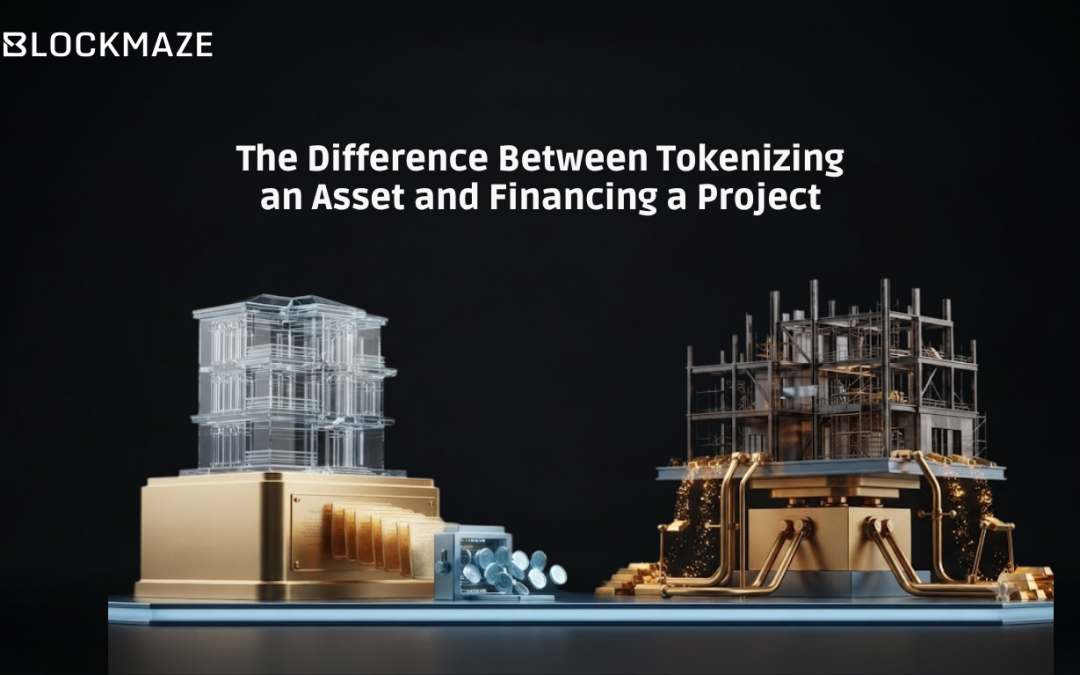
Securitization the traditional finance discipline underlying most asset tokenization today takes an existing, cash-flow-generating asset (a portfolio of mortgages, a completed building, a bond) and repackages ownership or the right to its cash flows into tradeable instruments. The defining feature is that the underlying asset already exists and its cash flow characteristics, while not certain, are reasonably well understood from historical performance or contractual terms. A tokenized version of this instrument changes how ownership is recorded and transferred; it does not change the fundamental nature of the claim being represented.
This is why asset tokenization has scaled fastest in exactly the categories dominating the major market forecasts: Treasuries, money market funds, completed real estate, and private credit already generating interest payments. Each of these has a known, or contractually defined, cash flow stream that a token can represent cleanly as a fixed, transferable unit.
Project Finance: A Claim on Something That Doesn’t Exist Yet
Project finance is structurally different from the ground up. It finances the construction or development of an asset that does not yet generate revenue a toll road, a power plant, a data centre, a film using the projected future cash flows of the completed asset as the basis for repayment, rather than the balance sheet of the sponsoring company. Because the underlying asset does not exist yet, project finance lenders do not release the full loan amount upfront. Capital is drawn down in tranches tied to construction milestones foundation complete, structure topped out, equipment installed, commissioning achieved with independent engineers or inspectors verifying each milestone before the next tranche releases.
This staged structure exists because construction risk is fundamentally different from the risk of holding an already-completed asset: a project can stall, run over budget, or fail to reach completion entirely, and a lender’s exposure needs to track the project’s actual progress rather than being fully committed on day one against a promise. Traditional project finance also typically includes step-in rights, allowing lenders to take control of a stalled project and bring in a replacement contractor or operator a governance mechanism asset securitization simply does not need, because there is no construction process to take over.
Why Tokenization Infrastructure Has Skewed Toward Assets, Not Projects
The practical reason most tokenization infrastructure supports asset representation rather than project financing is not a lack of ambition it is that the asset-representation model is genuinely easier to build. A token representing a fixed claim on an existing asset requires identity verification, transfer restrictions, and a compliant register a well-understood engineering problem tokenization platforms have largely solved. A token representing a claim on a project still under construction requires all of that, plus a mechanism for verifying milestone completion, a structure for releasing capital in tranches rather than all at once, and a governance framework for handling delays, cost overruns or contractor disputes problems that sit closer to project management and construction finance than to securities settlement.
This is a large part of why the tokenization market has grown fastest in already-liquid asset classes and remains comparatively undeveloped for genuine project finance use cases, even though project finance infrastructure, deep tech facilities, real estate development, film production is exactly where the underserved capital formation problem this analysis has identified actually sits.
What Financing a Project Through Tokenized Capital Actually Requires
Building tokenized infrastructure genuinely capable of financing a project, rather than merely representing a finished asset, means solving for capabilities asset tokenization does not need: staged capital release tied to independently verified milestones; a mechanism for investors to assess and price construction-stage risk differently from completion-stage risk within the same instrument; governance rights that activate if a project underperforms or stalls, comparable to a lender’s traditional step-in rights; and a legal structure that can convert from a construction-risk instrument into a completed-asset instrument once the project reaches operational status, since the risk profile and often the appropriate investor base changes materially at that point.
| Feature | Asset Tokenization | Project Financing (Tokenized) |
|---|---|---|
| Underlying state | Already exists, generates known/contractual cash flow | Does not yet exist or is incomplete; future cash flow is contingent |
| Capital release | Single issuance event | Staged, tied to independently verified milestones |
| Primary risk | Market, credit, or asset-performance risk | Construction, completion, and cost-overrun risk |
| Governance need | Minimal ownership transfer and corporate actions | Active step-in rights, milestone disputes, delay remediation |
| Traditional finance analogue | Securitization (RMBS, ABS, bond issuance) | Project finance, construction lending, concession financing |
| Where tokenization has scaled | Extensively Treasuries, funds, completed real estate | Minimally construction-stage capital remains largely untokenized |
Why the Distinction Should Shape What Gets Built Next
Treating project financing as a variant of asset tokenization, rather than as its own discipline, produces infrastructure poorly suited to the use case that most needs it. A platform built to tokenize a finished office building can technically be repurposed to raise capital for one still under construction, but without milestone verification, staged capital release and step-in governance, it is offering investors a completed-asset instrument’s simplicity against a construction-stage project’s actual risk profile a mismatch that either understates the risk to investors or forces sponsors to raise capital in a single, less flexible tranche that doesn’t reflect how construction risk actually unfolds. Purpose-built project finance infrastructure, designed from the outset around staged verification and governance, is what closes that gap.
Blockmaze and Project-Stage Capital Formation
Blockmaze’s infrastructure is built to support both models without forcing project financing into an asset-tokenization structure it was never designed for. Compliance-enforced transfer restrictions and identity-verified allowlists provide the same regulatory discipline for a project-stage instrument that they do for a completed asset, while the platform’s architecture supports staged capital structures and governance provisions suited to projects still under development, not only assets already generating cash flow.
DAO governance offers the structured, multi-stakeholder decision rights that milestone-based projects require a mechanism far closer to a lender’s traditional step-in framework than to simple ownership transfer. As capital formation infrastructure matures beyond digitizing already-completed assets, building genuinely for the project financing side of that distinction not adapting asset tokenization tools after the fact is what will determine whether tokenization reaches the capital-intensive projects that need it most.
Frequently Asked Questions
1. What is the core difference between asset tokenization and tokenized project financing?
Asset tokenization represents ownership of something that already exists with a known or contractual cash flow. Project financing raises capital for something not yet complete, where cash flow is contingent on reaching construction or development milestones, and capital is typically released in stages rather than all at once.
2. Why has most tokenization infrastructure been built for assets rather than projects?
Representing a fixed claim on an existing asset is a more contained engineering problem identity verification, transfer restrictions and a compliant register. Project financing additionally requires milestone verification, staged capital release, and governance mechanisms for delays or underperformance, which are closer to construction finance than to securities settlement.
3. What are step-in rights and why do they matter for project finance?
Step-in rights allow a lender or capital provider to take control of a stalled or failing project for example, replacing a contractor to protect their capital. Asset tokenization does not require this because there is no ongoing construction process to take over.
4. Can a platform built for asset tokenization be used for project financing?
Technically it can be repurposed, but without milestone verification, staged capital release and governance rights, it mismatches a completed-asset instrument’s simplicity against construction-stage risk which either understates risk to investors or limits how sponsors can structure the raise.
5. Which sectors are most affected by this gap in tokenization infrastructure?
Infrastructure development, deep tech facilities requiring long build-out periods, real estate at the pre-construction and construction stages, and film production all categories where capital needs to be released in stages tied to project progress rather than in a single upfront issuance.
Disclaimer: This article is for informational purposes only and does not constitute financial or legal advice. Readers should conduct their own research and consult with qualified professionals before making any investment or business decisions.