
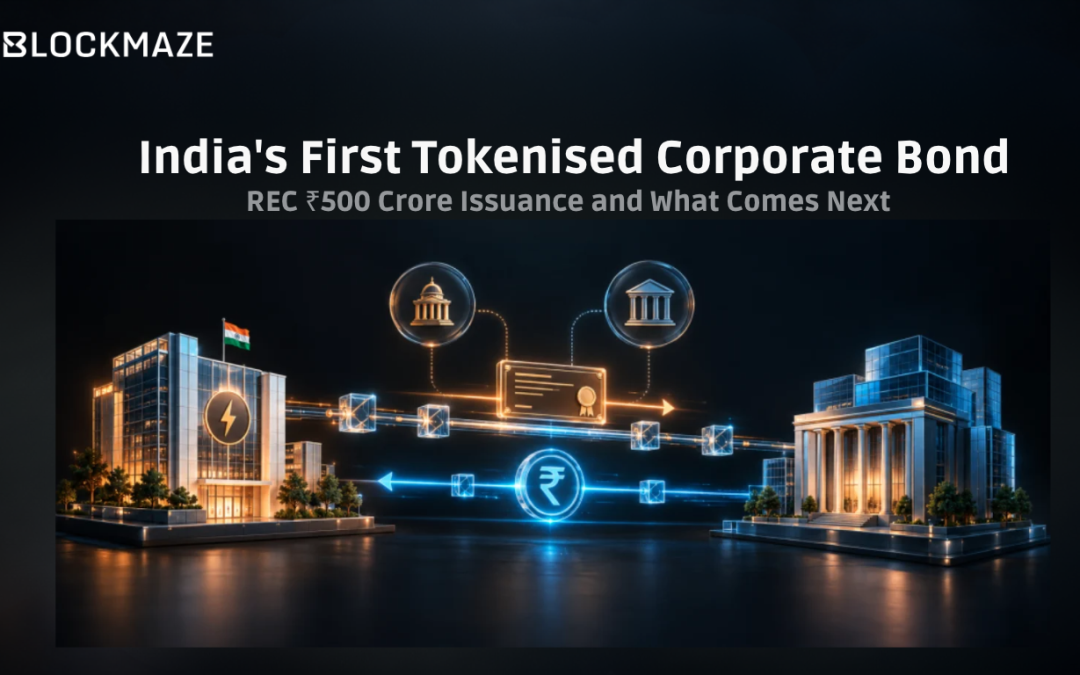
Key Facts• REC Limited — state-owned power financier, Maharatna company, AAA-rated by CARE, ICRA, and India Ratings — issued India’s first tokenised corporate bond: ₹500 crore (base ₹100 crore plus greenshoe of ₹400 crore), coupon 7.30%, maturing May 31, 2028. This is confirmed. • Settlement was executed via the Reserve Bank of India’s wholesale CBDC wallets — atomic delivery-versus-payment, with the bond and the cash changing hands simultaneously on a distributed ledger. India’s traditional corporate bond settlement operates on a T+1 cycle. • Ownership is recorded through SEBI’s DEMAT 2.0 electronic wallet, a DLT-based system. Participation is restricted to institutional investors holding active securities accounts and RBI wholesale CBDC wallets. A mandatory three-month lock-in applies before secondary market trading. • According to sources cited by LiveMint, Larsen and Toubro (L&T) is understood to be the next issuer in line — planning up to ₹500 crore at approximately 7.40% with a three-year maturity. L&T had not confirmed these details at the time of publication and did not respond to LiveMint’s enquiry. • The pilot is a joint RBI-SEBI initiative. SEBI Chairman Tuhin Kanta Pandey announced the DLT tokenisation pilot at the Debt Market Summit in May 2026. Secondary market infrastructure is targeted for December 2026. |
India’s corporate bond market is the largest single destination of domestic institutional capital — ₹59 lakh crore (approximately $624 billion) in outstanding debt, with ₹2.65 lakh crore privately placed across 603 issues in the April–July 2026 window alone. When the country’s central bank and securities regulator jointly pilot a structural change to how bonds are issued, owned, and settled in that market, it is not an experiment in the margins. It is an attempt to change the fundamental mechanics of the most important capital market in the world’s fifth-largest economy.
The REC issuance is small by design — ₹500 crore against a market of tens of lakhs of crore — because that is how consequential infrastructure changes are correctly introduced. The question is not whether ₹500 crore matters. The question is what the architecture of that issuance reveals about where India’s bond market is going.
The Architecture of the Pilot
Why REC Was the Right First Issuer
REC Limited is an unusual institution: a Maharatna company under the administrative control of India’s Ministry of Power, simultaneously registered with the RBI as a Non-Banking Finance Company, a Public Financial Institution, and an Infrastructure Finance Company. That overlapping regulatory footprint — spanning both SEBI’s securities ecosystem and RBI’s financial institution ecosystem — made REC the logical first issuer for a pilot that is itself a joint RBI-SEBI initiative. The credit risk is absent: AAA ratings across all three domestic agencies mean institutional investors are evaluating the structural innovation, not the issuer credit.
The Three Infrastructure Layers
The REC tokenised bond pilot combines three infrastructure layers that are each significant individually and more significant in combination:
| Infrastructure Layer | What It Does | Why It Matters |
|---|---|---|
| SEBI DEMAT 2.0 wallet | Records bond ownership and transfers on a distributed ledger rather than through the traditional centralised depository (CDSL/NSDL) model | Replaces the reconciliation-dependent centralised record with a shared DLT register — directly addressing the traceability and transparency objectives SEBI cited in May 2026 |
| RBI wholesale CBDC wallet | Provides the payment leg of the delivery-versus-payment settlement — digital rupee issued by the central bank | Enables atomic settlement: bond and cash move simultaneously with no T+1 gap and no settlement risk between delivery and payment |
| Atomic DvP settlement | The security and the payment are exchanged simultaneously in a single transaction — neither completes without the other | Eliminates the settlement interval during which one party has delivered and the other has not — a risk that traditional T+1 settlement creates on every transaction |
What Institutional Participation Requires
The pilot is not open to retail investors or to institutions without specific infrastructure. Only institutional investors holding both active securities accounts and RBI wholesale CBDC wallets are eligible to participate in the bidding process. This is a deliberate design choice: the RBI’s wholesale CBDC programme has been in testing since late 2022, initially focused on interbank government securities transactions. Participants in the corporate bond pilot are institutions that have already integrated into the wholesale CBDC ecosystem — a prerequisite that simultaneously limits initial participation and ensures that every participant has the infrastructure to settle correctly.
Bonds issued under the pilot carry a mandatory three-month lock-in period before secondary market trading becomes available. Secondary market infrastructure is targeted for December 2026.
Who May Be Next: Sources Point to L&T
According to sources reported by LiveMint, Larsen and Toubro — India’s largest engineering and infrastructure conglomerate — is understood to be the next issuer lined up for a tokenised bond issuance of up to ₹500 crore. Sources indicate the bonds may carry a coupon of approximately 7.40% with a three-year maturity, to be placed on an electronic platform for institutional bidding.
L&T had not officially confirmed these plans at the time of publication, and did not respond to LiveMint’s enquiry. This article treats the L&T detail as market intelligence — reported by sources, not confirmed by the company — and will be updated when L&T makes an official statement.
If confirmed, the significance of L&T’s participation would extend beyond the transaction size. REC is state-owned and quasi-sovereign — its participation in the pilot reflects a regulatory expectation as much as a commercial decision. L&T is a private sector issuer. A confirmed L&T issuance would signal that private sector corporates see commercial merit in the tokenised bond infrastructure independently of any regulatory direction — converting the pilot from a government-led exercise into the beginning of a market-wide pattern.
Beyond L&T, multiple other state-owned financial institutions are understood to be evaluating tokenised bond programmes, according to market participants. The pipeline — whether confirmed or in earlier stages of evaluation — is not limited to the two institutions identified publicly.
What T+0 Atomic Settlement Actually Changes
India’s existing T+1 corporate bond settlement creates a specific risk accepted as a cost of doing business: between the moment a trade is agreed and the moment it settles, one party has committed to deliver but neither party has delivered. During that interval, the delivering party carries counterparty risk on the receiving party and vice versa. The magnitude of that risk is proportional to the settlement interval, which is why reducing settlement from T+2 to T+1 represents a genuine risk reduction rather than merely a speed improvement.
Atomic delivery-versus-payment — the bond and the CBDC payment moving simultaneously — reduces the settlement interval to effectively zero. There is no counterparty risk during settlement because there is no settlement interval. The trade agrees and settles in the same operation. This is not a marginal improvement on T+1. It is a different settlement architecture.
The practical implication for institutional participants extends beyond settlement risk. Collateral management becomes more efficient when bonds settle instantly — capital sitting in margin accounts to cover settlement exposure can be redeployed. And the automated servicing that SEBI cited as a pilot objective — coupon payments, redemption processing, ownership register maintenance — becomes significantly more tractable when the instrument’s ownership record is on a shared DLT rather than reconciled between multiple centralised systems.
India in the Global Context
India is not the first jurisdiction to pilot tokenised government or corporate bonds. The Hong Kong Monetary Authority completed tokenised green bond issuances under Project Evergreen. The European Investment Bank issued tokenised bonds on Ethereum. The BIS’s Project Genesis and Project Guardian explored tokenised bond settlement across multiple central bank jurisdictions. What India brings to this context is scale: a $624 billion corporate bond market with deep institutional participation, a wholesale CBDC infrastructure already operational for interbank government securities transactions, and two of the world’s most proactive financial regulators jointly sponsoring the pilot.
The SEBI DEMAT 2.0 architecture is more structurally ambitious than most tokenised bond pilots elsewhere, which have typically layered blockchain settlement on top of existing centralised custody infrastructure rather than replacing the ownership record layer itself. Whether that architecture scales to the full corporate bond market is the question the December 2026 secondary market launch will begin to answer.
What Remains Open
An honest assessment of the pilot has to name the constraints. The three-month lock-in period before secondary market trading reflects the absence of functioning secondary market infrastructure at launch — the pilot’s designers are aware of this and targeting December 2026 to address it. Without secondary market liquidity, the tokenised bond’s primary operational advantage — real-time DLT-based ownership transfer — is temporarily unavailable to initial purchasers. This is a sequencing constraint, not a structural failure, but it means the pilot’s first investor cohort is primarily evaluating issuance and primary settlement mechanics rather than secondary market functionality.
The CBDC wallet prerequisite also limits initial participation to institutions already integrated into the RBI’s wholesale CBDC ecosystem. As the programme expands, this constraint will ease — but the pilot’s initial demand signal comes from a self-selected, infrastructure-ready cohort rather than the full institutional market.
Frequently Asked Questions
What is India’s first tokenised corporate bond?
REC Limited’s ₹500 crore issuance — base ₹100 crore plus a greenshoe option of ₹400 crore — settled via the RBI’s wholesale CBDC wallets with atomic delivery-versus-payment. The bonds carry a 7.30% coupon and mature May 31, 2028. This is the first corporate bond in India to use blockchain technology for issuance, ownership recording, and settlement.
What is SEBI DEMAT 2.0?
SEBI’s new DLT-based electronic wallet system that records bond ownership and transfers on a distributed ledger rather than through the traditional centralised depository model (CDSL/NSDL). It is the ownership record layer of the tokenised bond pilot — distinct from the payment layer, which uses RBI’s wholesale CBDC.
What is atomic delivery-versus-payment and why does it matter?
Atomic DvP means the bond and the cash payment move simultaneously in a single transaction — neither completes without the other, and there is no settlement interval between delivery and payment. India’s traditional corporate bond settlement operates on T+1, meaning one business day passes between trade execution and final settlement. Atomic DvP eliminates that interval and the counterparty risk it creates.
Is L&T confirmed as the next tokenised bond issuer?
Not yet confirmed. According to sources reported by LiveMint, L&T is understood to be planning a tokenised bond issuance of up to ₹500 crore at approximately 7.40% with a three-year maturity. L&T had not officially confirmed these plans and did not respond to LiveMint’s enquiry at time of publication. This article will be updated when L&T makes an official statement.
Who can participate in the tokenised bond pilot?
Only institutional investors holding both active securities accounts and RBI wholesale CBDC wallets. Retail investors are excluded. A mandatory three-month lock-in period applies before any secondary market trading, with secondary market infrastructure targeted for December 2026.
How does India’s pilot compare to tokenised bond initiatives elsewhere?
India joins Hong Kong (Project Evergreen), the EIB, and multiple BIS project jurisdictions in piloting tokenised bond issuance. India’s specific contribution is the combination of a $624 billion corporate bond market, an operational wholesale CBDC infrastructure, and a DEMAT 2.0 architecture that replaces centralised ownership records with DLT — more structurally ambitious than most international precedents, which layer blockchain on top of existing centralised custody.
Blockmaze and India’s Tokenised Capital Markets
The infrastructure architecture that India’s RBI-SEBI pilot demonstrates — DLT-recorded ownership, atomic CBDC settlement, compliance-enforced participation, and governance for the servicing lifecycle — is precisely the architecture Blockmaze is building for private capital formation across the GCC, South Asia, and institutional markets globally. India’s pilot proves that regulators and state-owned issuers accept this architecture as production-grade. The next phase — if market sources prove correct — is private sector issuers adopting it for their capital market needs independently of regulatory direction. And beyond sovereign and quasi-sovereign bonds, the same infrastructure serves the capital formation use cases that traditional bond markets have never effectively reached: infrastructure development finance, real estate construction capital, deep tech funding, and private business growth capital. For institutional issuers in India and across the region evaluating tokenised bond infrastructure, Blockmaze provides the compliance-enforced issuance layer, Proof of Reserve attestation, and DAO governance that the full instrument lifecycle requires — from issuance through to redemption.
Disclaimer: This article is for informational purposes only and does not constitute financial or legal advice. Readers should conduct their own research and consult with qualified professionals before making any investment or business decisions.