
Executive TL;DR
|
The Gulf’s infrastructure ambition is not in doubt Saudi Arabia alone has assembled the largest construction pipeline of any single country in the world. What has become clear over the past two years is that even the region’s largest sovereign wealth fund cannot underwrite that ambition indefinitely from its own balance sheet, and the recalibration now underway at NEOM and across Saudi Arabia’s giga-project portfolio is the clearest evidence yet that the region’s mega-projects need capital formation models that go well beyond direct sovereign funding.
The Scale of Saudi Arabia’s Giga-Project Ambition
Saudi Arabia has more than 12 giga-projects underway under Vision 2030, with a combined estimated investment of $1.1-1.3 trillion, according to 2026 industry tracking the largest construction pipeline of any single country, exceeding the combined infrastructure spending of most G7 nations. NEOM anchors the portfolio as the flagship umbrella project, with sub-projects including The Line, Trojena, Oxagon, and Sindalah, alongside other giga-projects like Qiddiya, Red Sea Global, ROSHN, and Diriyah spanning entertainment, housing, tourism, and cultural development. Several of these projects have already reached operational status Red Sea Global’s Phase 1 is open, KAFD is occupied, and ROSHN has delivered thousands of homes demonstrating genuine execution alongside the more speculative headline ambitions.
NEOM’s Recalibration: What Happens When Ambition Outpaces Fiscal Capacity
NEOM’s own trajectory illustrates the limits of sovereign-balance-sheet-only financing most starkly. Announced by Crown Prince Mohammed bin Salman at the inaugural Future Investment Initiative in October 2017 with a $500 billion price tag, NEOM was pitched as a cross-sector economic zone the size of Belgium. A leaked 2023 internal board presentation, reported by the Wall Street Journal, projected total build-out costs of $8.8 trillion by 2080 with $370 billion required for Phase 1 alone by 2035 figures the Gulf International Forum’s analysis describes as far exceeding fiscal capacity, incorporating input assumptions on tourism revenue and population growth that internal audits later deemed improbable. By 2026, approximately $50 billion had actually been spent, and the original 2017 vision has been described by regional analysts as substantially scaled back from its launch-film ambitions.
This is not a story of Vision 2030’s collapse Red Sea Global, ROSHN, and other giga-projects continue to deliver but it is a clear signal that sovereign balance sheet funding, however large, has real limits when a single project’s full ambition scales into the trillions. The Public Investment Fund’s 2026-2030 strategy has formalised the response, restructuring its portfolio around what the Gulf International Forum describes as “vision, strategy, and finance,” with explicit emphasis on investment efficiency, domestic value creation, and building competitive national ecosystems a deliberate shift toward capital discipline rather than continued unlimited direct funding of every giga-project ambition.
The Broader GCC Picture: Real Diversification, Real Financing Needs
The recalibration at NEOM sits within a genuinely successful broader diversification story. Non-oil sectors now account for approximately 71% of Saudi Arabia’s GDP and 75% of the UAE’s, according to 2026 regional economic analysis a structural shift away from hydrocarbon dependency that infrastructure investment has directly enabled. Knight Frank’s analysis estimates nearly $1 trillion in real estate and infrastructure has been announced across Saudi Arabia since 2016, with roughly $300 billion specifically dedicated to new infrastructure and, according to Knight Frank’s own head of Middle East research, this figure represents only about a third of the total spend ultimately planned, implying an eventual multi-trillion-dollar ambition across the full programme.
The UAE’s own infrastructure pipeline runs alongside Saudi Arabia’s at comparable ambition, and together the two economies are catalysing what 2026 regional analysis describes as a multi-trillion-dollar development ecosystem spanning transport, tourism, logistics, digital infrastructure, and next-generation urban environments a scale of simultaneous, multi-sector infrastructure development that would strain even a well-resourced sovereign fund’s capacity to finance entirely through direct balance sheet deployment.
Why Sovereign Balance Sheets Alone Were Never Going to Be Enough
The structural issue NEOM’s recalibration exposes is not specific to one project or one fund it is a version of the same capital concentration problem this series has identified globally. The Public Investment Fund, however large, is one balance sheet; funding a $1.1-1.3 trillion giga-project pipeline directly, on top of its existing global investment portfolio and its role backing MGX, Alat, and other strategic technology vehicles this series’ analysis of sovereign wealth funds and deep tech has already documented, means every giga-project ultimately competes with every other PIF priority for the same finite pool of sovereign capital and borrowing capacity.
This is precisely why the PIF’s 2026-2030 strategic pivot toward “domestic value creation” and “competitive national ecosystems” matters: it signals an explicit shift toward structures that bring in capital and capability beyond PIF’s own direct funding, rather than continuing to treat every giga-project component as a wholly sovereign-financed undertaking. Ports, power infrastructure, data centres, and real estate development within these giga-projects are each, individually, exactly the kind of capital-intensive, cash-flow-generating infrastructure this series’ broader analysis has shown to be well suited to project finance structures involving external capital not categories that require the sovereign balance sheet to fund every layer directly.
What New Capital Formation Models Would Actually Add
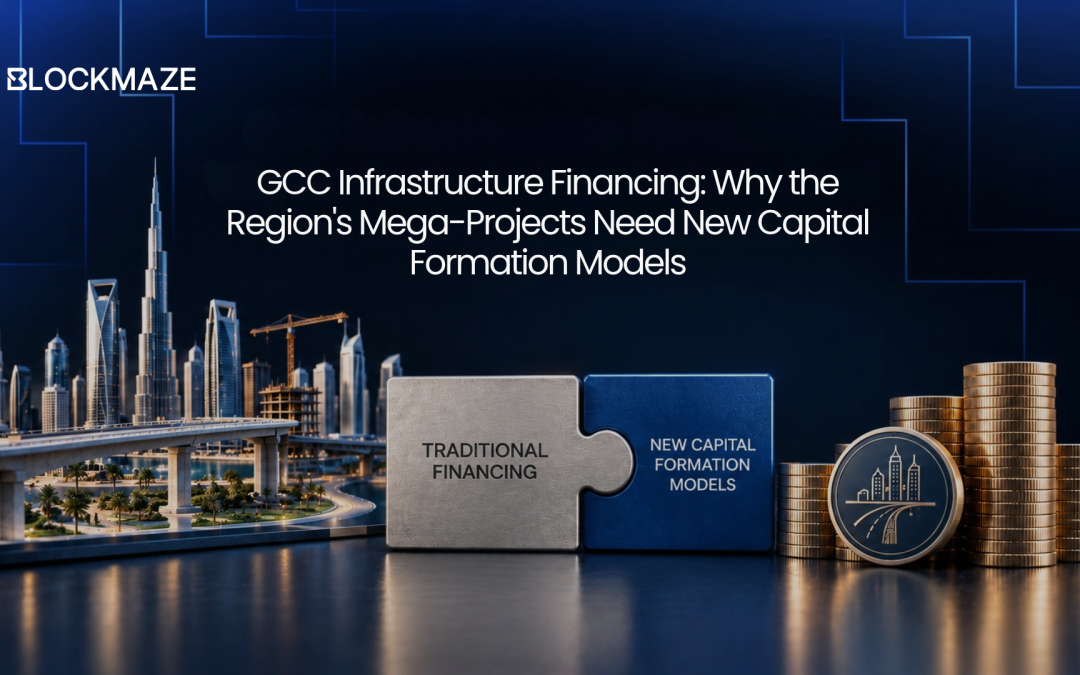
Bringing genuinely diversified, global private capital into specific components of GCC giga-projects a power plant serving NEOM’s Oxagon industrial zone, a data centre supporting the region’s broader digital ambitions, a real estate development within Red Sea Global requires capital formation infrastructure capable of packaging these components for a global investor base without every transaction requiring the direct, whole-project sovereign underwriting the region has relied on to date. This does not mean sovereign capital disappears from the picture; PIF and its regional peers remain the natural equity sponsors and strategic anchors for these projects. It means the debt and mezzanine layers within each project component can be distributed more broadly, following the same tokenized-alongside-conventional-financing logic this series’ analysis of syndicated bank debt has already described, extending the region’s genuine infrastructure ambition beyond what any single sovereign balance sheet, however large, can sustainably fund alone.
Blockmaze and GCC Capital Formation
Blockmaze’s licensing footprint across the GCC and its focus on compliant, cross-border capital formation are built for exactly the structural need this analysis identifies bringing genuinely diversified, global private capital into specific components of the region’s giga-projects without requiring every layer of every project to be funded directly from sovereign balance sheets. Compliance-enforced transfer restrictions and identity-verified allowlists let a power plant, data centre, or real estate development within a larger giga-project reach a properly verified global investor base as a distinct, well-structured opportunity in its own right.
DAO governance and Proof of Reserve verification every 15 days extend the same institutional-grade discipline sovereign lead sponsors already apply, giving external capital providers the continuous confidence needed to participate meaningfully in project components rather than requiring the whole-project sovereign underwriting the region has relied on to date. As Saudi Arabia and its regional peers work through exactly the kind of fiscal recalibration NEOM’s cost overrun made unavoidable, capital formation infrastructure built to extend giga-project ambition beyond sovereign balance sheets alone is where the region’s next phase of delivery will be financed.
Frequently Asked Questions
1. How much has NEOM actually cost compared to its original budget?
NEOM was pitched at $500 billion in 2017. A leaked internal board presentation reported by the Wall Street Journal projected full build-out costs of $8.8 trillion by 2080, with $370 billion needed for Phase 1 alone by 2035. Approximately $50 billion had actually been spent by 2026.
2. What is the combined value of Saudi Arabia’s giga-projects under Vision 2030?
More than 12 giga-projects with a combined estimated investment of $1.1-1.3 trillion, according to 2026 industry tracking the largest construction pipeline of any single country in the world.
3. Has Saudi Arabia’s Public Investment Fund changed its approach to funding megaprojects?
Yes. PIF’s 2026-2030 strategy has formally restructured around investment efficiency, domestic value creation, and building competitive national ecosystems a deliberate pivot away from unlimited direct sovereign funding of every giga-project ambition.
4. How much of Saudi Arabia and the UAE’s economies now come from non-oil sectors?
Approximately 71% of Saudi Arabia’s GDP and 75% of the UAE’s GDP now come from non-oil sectors, according to 2026 regional economic analysis a structural diversification that infrastructure investment has directly enabled.
5. Why can’t sovereign wealth funds finance GCC giga-projects entirely on their own?
A giga-project pipeline of $1.1-1.3 trillion competes with a sovereign fund’s other global investment priorities and strategic commitments for the same finite pool of capital and borrowing capacity a concentration risk that NEOM’s cost recalibration illustrates directly.
Disclaimer: This article is for informational purposes only and does not constitute financial or legal advice. Readers should conduct their own research and consult with qualified professionals before making any investment or business decisions.