
Executive Summary
- Venture capital is concentrated. In 2025, about half of US venture dollars went to 1% of deals, and the 15 largest firms took 88.5% of commitments raised in Q1 2026.
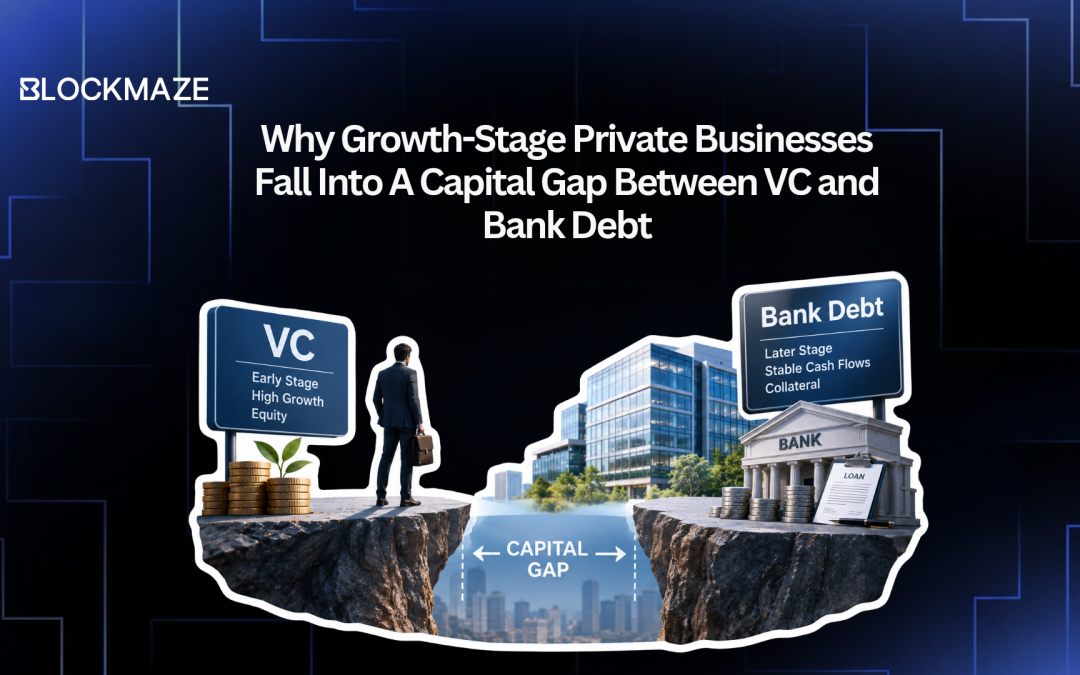
- That leaves a “missing middle”. These are fast-growing, often profitable companies whose financing needs don’t fit what venture now funds.
- The alternatives fit poorly.
- Bank debt is priced on collateral and steady cash flow, which many grDilutiveowth-stage companies lack.
- Venture debt, at a record $62.4 billion in 2025, is underwritten against a future liquidity event and bridges to more venture funding.
- Growth equity brings dilution and board oversight, which many owners want to avoid.
- The usual financing ladder doesn’t hold. Capital is plentiful at both ends of the spectrum and thin in the middle.
Venture Capital has Concentrated at the Top
The market where growth-stage companies once raised venture capital has consolidated dramatically. According to PitchBook’s 2025 Annual Valuations Report, the prior year marked a significant change where half of all venture dollars invested were in the top 1% of all completed deals. The top 10 of those deals accounted for 40% of the total deal value. This trend continued in 2026, where Wellington Management’s mid-year outlook reported the top five venture capital firms by capital raised accounted for 73.1% of all venture commitments in the first quarter, and the top 15 accounted for 88.5%. Again, Wellington’s analysis is direct, stating that this is a structural shift, where larger funds, constrained by the laws of supply and demand, are restricted to larger, later-stage financings. In their opinion, this trend will continue with the upper-end, of what is typically considered the venture capital and private equity markets, significantly growing from single-digit, to mid, and high-teens, and even tens of billions of dollars, and financing concentrated around a small group of AI-driven, category winners.
Another consequence of this repricing is reflected in PitchBook’s estimation that 222 of 857 tracked unicorns may have slid back below the $1 billion valuation. This serves as a reminder that the headline strength of the venture market conceals considerable repricing for the companies outside the small, consensus-driven, winner-takes-all group that currently dominates the market, and absorbs the lion’s share of available capital.
‘The Missing Middle’ This Concentration Has Created
Analysis of the venture debt market identifies this gap specifically as ‘the missing middle’: companies that are still growing, but have financing needs that are not aligned with what an increasingly AI-centered venture market looks for. Many of these companies are already generating and growing revenue. The problem is not with the company, but rather that the market has no appetite for long-term, growth-at-a-reasonable-rate investments. These companies also lack the scale and other characteristics to meet the requirements of a traditional bank.
Why Bank Debt Doesn’t Fill the Gap
Traditional bank lending is based on collateral and cash flow. Growth-stage companies, including profitable ones, are rarely able to provide these. Bank lending is less able to evaluate businesses investing aggressively to grow profits and the workforce. Banks seek businesses that trade stability and profitability for a different type of growth. The structural mismatch between banks’ lending criteria and growth-stage businesses is highlighted by the series’ analysis of Basel III’s impact on middle-market and construction lending. Banks are trying to offset risk by lending to businesses where they are underwriting for stability and collateral.
Venture Debt: A Bridge, Not a Destination
Venture debt has begun to fill this gap, reaching a record $62.4 billion in 2025, up from $61.1 billion in 2024, with the lender base shifting significantly after the failure of Silicon Valley Bank in 2023 and the entry of more non-bank lenders. While venture debt has typically relied on an underwriting model to assess risk, with availably and pricing based on a firm’s sponsorship and quality, as well as the firms’ expected ability to access subsequent equity financings or other liquidity events, thus making it a bridge to access more Venture Capital. It is important to note that industry guidance is clear, venture debt is a bridge, not a destination. As such, most lower-middle market facilities are expected to be refinanced into other structures or paid down via an equity event in the 24-36 month timeframe.
Consequently, for a business looking to continually grow and expand without raising further equity financings, venture debt would clearly not be a viable alternative to meet the firms’ long-term capital needs.
Growth Equity: Somewhat Less Dilutive
Growth equity bridges the space between VC and buyout private equity. It provides growth capital to businesses that are profitable and growing, to fund growth through either organic or inorganic means, or provide partial exit to founders. However, growth equity requires a preference stack, board representation and an equity dilution that makes growth equity an imperfect solution for a profitably growing business. This is especially true if the capital need of the business does not warrant a full growth equity raise. For the missing middle, an investment structure that offers growth and/or liquidity to shareholders, without making control of the business irrelevant and requiring a full equity dilution would most likely be preferred.
The Structure of the Gap
There are large disparate pools of capital for highly speculative and highly certain outcomes respectively. On the speculative side, there is concentrated VC funding for large, rapidly growing AI companies. On the certain side, there is ample bank debt funding available only for businesses that are financially stable and secure enough to provide collateral. Venture debt is structurally tied to an expected future equity financing. Meanwhile, a growing, profitably business has varying needs and may not require such drastic changes to its equity and governance structure. The businesses in the gap created by the two extremes are not high risk, high growth, and low return businesses the way VC and bank funding typically address.
Frequently Asked Questions
1. How concentrated has venture capital become?
According to Wellington Management, in 2025, approximately half of all US venture dollars flowed into fewer than 1% of completed deals. Moreover, the top 15 venture firms by capital raised in the first quarter of 2026, captured 88.5% of all venture commitments.
2. What does ‘the missing middle’ mean in growth-stage financing?
This refers to companies that continue to grow and are often already profitable, but don’t meet what the concentrated, increasingly AI-focused venture market is interested in – either too mature or differently shaped for traditional VC.
3. Why doesn’t bank debt work for growth-stage companies?
Banks generally require historical financial statements as part of their underwriting process. However, many growth-stage companies, especially in technology, don’t have significant historical financial statements. Furthermore, bank debt is often structured over a relatively short period, typically 3-5 years, but growth-stage companies in technology, for example, are aiming to grow for a much longer period, often 10 years or more.
Bank debt is issued against collateral and stable, consistent cash flows. Banks typically will not provide debt capital to a growing company if the company is reinvesting profits, as the company would show thin or volatile net income.
4. Is venture debt a good alternative to raising another equity round?
Not really. Venture debt is typically underwritten based on a company’s ability to complete a subsequent equity financing or other liquidity event, meaning that it mostly bridges the next round of venture capital, and is not a good alternative for companies trying to avoid a dilutive round of financing.
5. What is the difference between growth equity, venture capital, and buyout private equity?
Growth equity fills the same role as venture capital in the later stages of a company’s lifecycle; however, growth equity generally invests in already-profitable, already-growing businesses. Additionally, growth equity does not carry the same level of control as a buyout private equity investment.
Disclaimer: This article is for informational purposes only and does not constitute financial or legal advice. Readers should conduct their own research and consult with qualified professionals before making any investment or business decisions.